


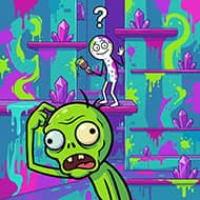


Meccha Chameleon looks like a chaotic party game, but it plays like a discipline. Every successful round of hiding demands colour theory, spatial awareness, and the ability to hold completely still while a Hunter walks within arm's reach. Released in June 2026 by indie developer Lemorion_1224, this multiplayer hide-and-seek game on PC became one of the fastest-selling indie releases in recent memory, crossing 15 million copies in under thirty days. The premise is simple: Chameleons paint themselves to blend into the map, and Hunters find them before the timer expires. Execution is anything but simple.
| Genre | Party / Hide-and-Seek |
| Platform | PC (Windows) |
| Players | 2–24 (recommended 10–12) |
| Modes | Basic, Infection, Double, Reverse Chicken Race |
| Maps | Mansion, Sewer, Backrooms, Sugarland, Osaka, Penguin Hotel + Steam Workshop |
The Prep Phase Is Where Meccha Chameleon Is Actually Won
When most players first join a Meccha Chameleon lobby, they sprint to a corner, slap some colour on, and freeze. They get found inside fifteen seconds. The prep phase — the window before Hunters are released — is not a rush to a hiding spot. It is the entire strategic layer of the game. Experienced Chameleons spend their prep time studying the surface they intend to blend with, sampling it precisely using the 3D Eyedropper, building a base coat, then tightening the detail work with a smaller brush.
The paint tool opens with F and contains more options than most players discover in their first hour. The basic Eyedropper samples a flat colour visible on screen. The 3D Eyedropper, activated by holding Space, locks to the contours of an object's surface and samples the exact shade at that specific angle. For players who wonder why their camouflage looks perfect from the front but obviously wrong from the side, the answer is almost always that they used the flat Eyedropper on a curved or angled surface instead of the 3D version. After sampling, adjusting brush size with right-click drag — wide for the initial coat, tight for edges and seams — closes the gaps that Hunters notice.
Pose selection matters as much as colour matching. Hunters find human silhouettes faster than colour inconsistencies. A perfectly painted character standing upright against a flat wall is still recognisable as a player because the shape reads wrong. The pose menu offers crouching, flat, curled, and several other options. Matching the pose to the geometry of the hiding spot — compact poses for low furniture, flat horizontal poses for floor-level spots, spread poses for wall-flush positions — is what separates players who survive until the final ten seconds from players who get tagged in the first sweep.
What Beginners Get Wrong About Hunter Play
Hunting in Meccha Chameleon is not a visual speed test. The most common mistake Hunters make is scanning too fast. A colour mismatch, a shadow pointing the wrong direction, a paint pattern that doesn't connect with the background geometry, a prop silhouette appearing where that prop shouldn't be — all of these give away hidden players immediately when you slow down, and disappear entirely when you sweep the room quickly. Players moving through rooms at a run almost always miss hiders that slower players would catch in seconds.
Zone control makes the difference in competitive lobbies. Hunters who move through rooms in sequence, clearing each one before proceeding, find more hiders than those who wander unpredictably. High-clutter areas — shelves, doorframes, connected rooms — are where Chameleons blend most easily, because visual noise hides small painting errors. Open, well-lit surfaces like floors and clean walls are the hardest places to hide effectively, because the Seeker's eye has nothing to compare against. Experienced Hunters check open areas quickly and spend their real time pressure-testing the cluttered ones.
There is one sound cue worth knowing. The forced taunt mechanic — available to Chameleons and on a timer — triggers an audible sound that gives away a hider's approximate position. When that sound fires during the hunt phase, it is one of the few moments that genuinely narrows the search, and Hunters who learn to react to it immediately convert it into eliminations far more often than those who ignore it.
Clones, Infection, and the Modes That Change Everything in Meccha Chameleon
The Basic mode — classic Chameleons hide, Hunters seek before the clock runs out — is where most players start. But Meccha Chameleon's other modes shift the game significantly. Infection converts every caught Chameleon into an additional Hunter, creating snowball pressure on the survivors. The last Chameleons standing face an ever-growing search team, and the pressure is audibly different. Hiding in the same spots that worked against two Hunters fails entirely against eight.
Double mode runs in reverse. Everyone begins as a Chameleon and gets the full prep phase to paint and position. Then the clock flips and everyone becomes a Hunter simultaneously. The player who finds the most hiders wins. Double rewards players who genuinely memorised their own position, because locating others means knowing exactly where to look — and veterans who spent time learning the map's best concealment spots are the same players who know where to search first when the phase shifts.
The clone mechanic is one of the more divisive tools in a competitive context. Chameleons can deploy up to two clones — static copies of their character — placed anywhere on the map. Against inexperienced Hunters, clones are convincing enough to waste significant search time. Against experienced Seekers, clones are often identified immediately because their positioning looks slightly off — propped against a surface the real player would have chosen differently. The community debate about clone value at higher skill levels is ongoing, with some players treating them as essential misdirection and others skipping them entirely in favour of spending that time perfecting colour matching instead.
Advanced Techniques Most Players Discover Late
The 3D colour picker — separate from the Eyedropper — allows manual fine-tuning of the sampled colour before applying it. Players who match a surface colour with the Eyedropper and then shift the hue or brightness slightly toward the shadow side of the object often blend more convincingly than those who match the flat average. Lighting in Meccha Chameleon is consistent enough on official maps that learning which direction the light source hits each hiding spot pays dividends across multiple rounds.
Size adjustment was added in the 1.6.0 update and remains underused. Shrinking the character model slightly before locking a pose allows Chameleons to fit into spaces that would otherwise clip visibly, and to press more convincingly against low-profile props. Competitive players who learned the game before size adjustment was available often overlook it even now. Expanding size, conversely, allows a player to blend with larger props by matching their footprint — turning into part of a bookshelf rather than something tucked against it.
Positioning relative to the results screen matters strategically if Meccha Chameleon's scoring is part of the calculation. Hiding in open sightlines scores more points for time spent visible but uncaught, while hiding in blind corners is safer but lower-scoring. Players who chase leaderboard positions have to weigh survival against visibility — the highest-scoring rounds often come from hiding in the most obvious spots and simply executing a flawless paint job.
Maps and What They Teach About Hiding in Meccha Chameleon
Each official map has a distinct visual language that rewards different hiding approaches. Mansion is the most forgiving for beginners — furniture density is high, colours are warm and varied, and there are enough surfaces with busy patterns that minor paint errors blend in. Players learning the paint tool do most of their skill development in Mansion lobbies because mistakes are survivable.
Osaka introduces a tighter colour palette and more geometric architecture. Surfaces are flatter and better lit, which means silhouette discipline matters more than in Mansion. The Osaka rework in a recent patch adjusted lighting and geometry, and players who had memorised its pre-patch hiding spots found their usual positions suddenly exposed. It is the map most discussed on community servers for how differently it reads compared to its earlier version.
Penguin Hotel and Sugarland attract attention from intermediate players because both offer unusual surface textures — ice and candy aesthetics respectively — that make colour-matching genuinely unusual. On Penguin Hotel, a blue-tinted white is not the same as the warm white of Mansion furniture, and players who do not resample for each map carry paint settings that betray them immediately. The Backrooms map, by contrast, is monotone enough that colour matching is straightforward, but the labyrinthine layout means Hunters who do not navigate systematically miss entire sections.
The Steam Workshop Incident and What It Means for Custom Maps
Custom maps via Steam Workshop have been one of Meccha Chameleon's most celebrated features — thousands of player-created environments extending the game far beyond its official map count. In mid-2026, two Workshop uploads named Laser Tag Neon and Chroma Grid Arena were found to contain malware that executed during match start, using a game vulnerability to download a remote access trojan. The vulnerability was patched in update 3.1.0, and both maps were removed. Players who launched either map before updating were advised to run a full system scan.
The incident revealed a broader issue: Steam Workshop runs minimal automated security checks on uploaded content, and the scale of a fast-growing game creates opportunity for bad actors. The developers were transparent about the fix and confirmed the game source files were not compromised. For players returning after the incident, the practical advice from the community is to update to the latest version before launching Workshop content, and to stick to maps with established review counts and known community sources.
The Workshop situation is the most honest dividing line in how players feel about Meccha Chameleon. Those who experienced the malware issue or saw it happen to others have been more cautious about custom maps since. Those who never encountered it — the majority — continue using Workshop content without friction, treating it as the best argument for the game's continued longevity.
Which mode is best for newcomers to Meccha Chameleon?
Basic mode is the right starting point. It introduces the core loop — prep phase painting, pose selection, and the hunt — without the added pressure of Infection's growing Hunter count or Double's reversed phase structure. Spending five to ten rounds in Basic lobbies, ideally on Mansion where the visual noise is forgiving, lets new players develop paint tool habits before the stakes escalate.
Do clones actually work against good Hunters?
At low to intermediate skill levels, clones reliably waste Hunter time and sometimes produce full eliminations when Hunters shoot a clone and move on. Against experienced Seekers, clones are identified faster because their positioning reads as placed rather than chosen — a real player would have pressed closer to the surface, matched the lighting angle more precisely, or chosen a spot that makes visual sense from the Hunter entry point. The community is genuinely split on whether clone use is worth the prep time at higher levels.
How does the Infection mode end?
Infection ends either when all Chameleons have been caught — at which point the Hunters win — or when the timer expires with at least one Chameleon still hidden, giving the surviving Chameleons the win. The escalating Hunter count makes the final minute of Infection genuinely different from Basic: more Hunters means faster coverage, so hiders who survive deep into an Infection round have usually chosen spots that are either exceptionally well-painted or positioned in areas that the growing search team has structurally overlooked.
Meccha Chameleon earns its reputation not from its visual polish — which the community describes without embarrassment as rough — but from how well its core painting system rewards patience and observation. The moment a full squad of Hunters walks past your Chameleon without a second glance, staring directly at the wall you dissolved into near the Osaka market stalls or the Penguin Hotel ice shelf, is one of the more genuinely satisfying things the game produces. The mechanics are simple enough to understand in one round and deep enough to improve at across hundreds.