



Machine learning is an essential component of artificial intelligence that enables computers to learn from data and make forecasts without needing to be explicitly programmed for each individual task. However, the quality of a machine learning model depends heavily on the data used to train and evaluate it. Two important concepts in this process are training data and testing data. Understanding the difference between them is essential for building accurate and reliable machine learning models. If you want to strengthen your AI knowledge and understand these concepts practically, consider enrolling in an Artificial Intelligence Course in Madurai at FITA Academy to build a strong foundation in artificial intelligence and machine learning.
What is Training Data in Machine Learning?
Training data refers to the information utilized to instruct a machine learning model on how to recognize patterns and correlations. It provides examples that help the model understand how different inputs connect to specific outputs.
For example, think about a machine learning model that is created to determine if an email is spam or authentic. The training data contains many examples of both spam and genuine emails. Each example helps the model recognize patterns such as suspicious links, repeated phrases, and unusual email addresses.
During training, the model studies these examples and adjusts its internal parameters to improve its predictions. The more relevant and diverse the training data is, the better the model can learn useful patterns.
What is Testing Data in Machine Learning?
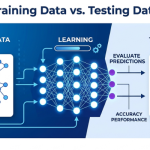
Testing data is a separate collection of information used to evaluate how well a trained machine learning model performs. Unlike training data, testing data is not used to teach the model.
Once the training process is complete, the model receives testing data to make predictions. These predictions are then compared with the actual answers to measure its performance.
For example, if an email classification model has learned from thousands of emails, testing data introduces new emails that the model has not previously seen. This helps determine whether the model can correctly classify unfamiliar messages.
Testing data provides a more realistic understanding of how a machine learning model may perform in real-world situations.
Key Differences Between Training Data and Testing Data
Although both datasets are important in machine learning, they serve different purposes.
- Purpose: Training data teaches the model, while testing data evaluates its performance.
- Usage: Training data is used during model development, whereas testing data is used after training.
- Learning: The model identifies patterns from training data but does not learn from testing data.
- Evaluation: Training data helps monitor learning, while testing data measures performance on unseen examples.
- Model quality: Testing data helps determine whether the model can generalize beyond the examples it has learned.
Keeping these datasets separate is important because it provides a fair evaluation of machine learning performance.
Why is Splitting Data Important in Machine Learning?
Splitting data helps determine whether a machine learning model can perform well on information it has never encountered before. If a model is evaluated using the same information it learned from, its performance may appear better than it actually is.
This problem can lead to overfitting. Overfitting happens when a model memorizes patterns from training data instead of learning relationships that apply to new information.
A proper data split helps identify this issue and provides a better understanding of the model's ability to make accurate predictions.
Common Data Splitting Ratios
The amount of data assigned to training and testing depends on the dataset size and the machine learning problem.
Some commonly used splitting ratios include:
- 80/20 Split: 80% of the data is used for training, and 20% is reserved for testing.
- 70/30 Split: 70% is used for training, while 30% is used for testing.
- 90/10 Split: 90% is used for training, and 10% is used for testing.
An 80/20 split is a common starting point for many machine learning projects. However, the ideal ratio depends on the amount of available data and the requirements of the project.
What is Validation Data and How is It Different?
Apart from training and testing data, machine learning projects may also use validation data. Validation data helps developers evaluate and improve a model during the development process.
It is commonly used to compare different models, adjust hyperparameters, and identify performance issues before final testing.
The three datasets have different responsibilities:
- Training data: Helps the model learn patterns.
- Validation data: Helps developers tune and improve the model.
- Testing data: Measures the final performance of the trained model.
Using separate datasets for these purposes helps create a more reliable evaluation process.
Best Practices for Preparing Training and Testing Data
Preparing high-quality datasets is essential for building effective machine learning models. Consider the following practices:
- Use relevant data: Select information that matches the problem you want to solve.
- Remove duplicate records: Avoid unnecessary repetition that could affect model learning.
- Handle missing values: Identify and manage incomplete information before training.
- Maintain data balance: Ensure that important categories are represented appropriately.
- Prevent data leakage: Make sure information from testing data does not influence model training.
- Keep testing data separate: Do not repeatedly use the test dataset to make development decisions.
Following these practices can improve model reliability and help produce more meaningful evaluation results.
Training data and testing data are essential components of the machine learning process. Training data helps models recognize patterns and learn from examples, while testing data measures how effectively they perform on unseen information. Understanding their differences helps developers avoid overfitting, prevent data leakage, and build more reliable machine learning solutions. As artificial intelligence continues to evolve, learning these fundamentals can help you explore advanced technologies and practical applications. If you are ready to expand your knowledge of modern AI technologies, explore Gen AI Courses in Madurai to develop your understanding of generative AI concepts and emerging applications.