




Large Language Models, or LLMs, can generate human-like text, answer questions, summarize documents, and assist with creative writing. However, their responses can change depending on how they select the next word or token. Two important concepts that control this process are temperature and sampling. Understanding temperature and sampling in LLM text generation helps you understand why an AI model sometimes gives predictable answers and sometimes produces more creative responses. If you want to build a strong foundation in these concepts, consider enrolling in a Generative AI Course in Cochin at FITA Academy to develop your practical knowledge of generative AI.
What is Temperature in LLM Text Generation
The temperature is a parameter that regulates the unpredictability of an LLM's responses. It influences how likely the model is to choose the most probable next token instead of considering less likely options. A lower temperature generally produces more predictable and focused responses, while a higher temperature allows greater variation in the generated text.
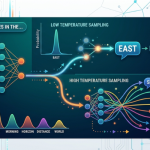
For example, imagine asking an AI model to complete the sentence, "The sun rises in the..." With a low temperature, the model is more likely to choose the word "east." With a higher temperature, the model may consider other possibilities, depending on the context and available token probabilities. Temperature does not add new knowledge to a model. Instead, it changes how the model selects its next token.
How Sampling Works in Large Language Models
Sampling is the process of selecting the next token from the possible options predicted by an LLM. After processing the input prompt, the model assigns a probability to each possible next token. The sampling method determines how these probabilities influence the final choice.
For instance, a model might assign a high probability to one word and lower probabilities to several alternatives. Sampling allows the model to select a token based on the probability distribution rather than always choosing the highest-probability option. This approach can make generated text more varied and natural.
Common sampling methods include greedy decoding, random sampling, top-k sampling, and top-p sampling. Greedy decoding always selects the most probable next token. Top-k sampling limits the available choices to a fixed number of likely tokens, while top-p sampling selects from a group of tokens whose combined probability reaches a chosen threshold.
How Temperature and Sampling Work Together
Temperature and sampling are closely related, but they perform different functions. Temperature adjusts the probability distribution of possible tokens, while sampling uses that distribution to select the next token.
A low temperature makes the probability distribution more concentrated around the most likely tokens. A high temperature makes the distribution flatter, allowing less likely tokens to have a greater chance of being selected. However, the final result also depends on the sampling method and other generation settings.
For example, a chatbot answering a factual question may benefit from a lower temperature because consistent answers are important. A tool used for brainstorming stories or marketing ideas may benefit from a higher temperature because varied suggestions are more useful. If you want to understand these concepts alongside other AI fundamentals, explore an Artificial Intelligence Course in Kochi to strengthen your knowledge of AI models and their practical applications.
Choosing the Right Temperature for Different Tasks
The best temperature depends on the purpose of the application. A temperature close to zero often produces more consistent outputs, although it does not guarantee factual accuracy or identical results in every system. Moderate temperatures can balance consistency with variety, while higher temperatures may be useful for creative tasks.
For example, use a lower temperature for structured summaries, straightforward question answering, and routine information extraction. Consider a moderate temperature for conversational assistants and content drafting. A higher temperature may suit creative storytelling, brainstorming, and generating alternative ideas.
These are general guidelines rather than fixed rules. The ideal setting depends on the model, the prompt, and the requirements of the task.
Temperature and sampling are essential concepts for understanding how Large Language Models generate text. Temperature influences the distribution of possible next tokens, while sampling determines how the model chooses among them. Learning how these settings work together helps you control the balance between predictable responses and creative variation. By trying out various configurations and assessing the outcomes, you can gain deeper insights into LLM behavior and enhance the quality of content generated by AI.