



Have you ever stared at a recipe that feeds four people, but you need to cook for ten, leaving you completely unsure of how much flour or sugar to add? Or perhaps you were shopping, trying to figure out whether buying the larger economy size of coffee actually saves you money compared to the smaller pack. These everyday dilemmas all boil down to one fundamental mathematical concept: proportions.
Fractions and ratios can feel intimidating, especially when you are in a rush. Fortunately, you do not have to struggle through complex cross-multiplication on a scrap of paper every single time. Using a reliable proportion calculator takes the guesswork out of the equation, giving you accurate results in a matter of seconds. Whether you are helping a child with their homework, scaling up a woodworking project, or tackling financial ratios, understanding how these relationships work makes life a whole lot easier.
In this comprehensive guide, we will explore everything you need to know about proportions, how direct and inverse relationships function, and how a proportion calculator can become your favorite daily tool.
Understanding Ratios and Proportions
Before diving into calculators, it helps to understand the underlying mechanics. At its core, a ratio is a comparison of two numbers. For example, if a classroom has twelve boys and eighteen girls, the ratio of boys to girls is twelve to eighteen.
A proportion takes things one step further by stating that two ratios are equal. If you simplify that classroom ratio, you find that for every two boys, there are three girls. Written mathematically, this looks like an equation of fractions: two-thirds equals four-sixths.
Direct Proportions Explained
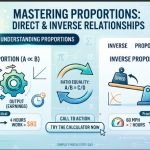
A direct proportion occurs when two values increase or decrease together at a constant rate. Imagine you are driving a car at a steady speed. If you travel sixty miles in one hour, you will travel one hundred twenty miles in two hours. As time goes up, distance goes up proportionally.
Common examples of direct relationships include:
-
Hourly wages where earning more hours means receiving more pay
-
Recipe ingredients when scaling portions up or down
-
Currency conversion rates when traveling abroad
When working with these scenarios manually, you use a method called cross-multiplication. You multiply the numerator of one fraction by the denominator of the other. When you use a digital proportion calculator, it performs this background math instantly, preventing simple arithmetic errors.
Inverse Proportions Explained
Not all relationships move in the same direction. An inverse proportion happens when one value increases while the other decreases.
Think about painting a room. If it takes one painter twelve hours to complete the job, hiring a second painter cuts the time in half to six hours. As the number of workers goes up, the time required to finish goes down.
Recognizing whether a problem requires a standard tool or an inverse proportion calculator is the most important step in solving it correctly. Using the wrong formula leads to incorrect results, which can ruin a recipe or a construction project.
How to Solve Proportions Step by Step
Learning how to set up an equation correctly ensures you get accurate results every time. Follow this simple framework when working through math challenges.
Step 1: Identify the Known Values
Read the word problem carefully and extract the numbers given. You will typically know three values and need to find a fourth missing value, often represented by a variable like $x$.
Step 2: Set Up the Equation
Write your two equivalent ratios as fractions with an equals sign between them. Make sure the units match across the top and bottom. For instance, if your numerator represents dollars, both numerators must represent dollars.
Step 3: Cross Multiply and Solve
Multiply the top-left number by the bottom-right number, and set it equal to the product of the bottom-left and top-right numbers. Divide the result by the remaining number to isolate your variable.
While doing this on paper is great for mental exercise, a dedicated online calculator saves immense time, especially when dealing with decimals, large numbers, or complex algebraic fractions. You simply type in your known values, and the tool outputs the answer immediately.
Practical Applications in Daily Life
Mathematics often feels abstract until you apply it to real-world scenarios. Proportions appear everywhere once you start looking for them.
Cooking and Baking
Culinary arts rely heavily on scaling. If a soup recipe calls for two cloves of garlic for every four servings, and you want to host a dinner party for twelve people, you need a quick ratio adjustment. Adjusting ingredients incorrectly ruins flavor profiles, but a quick calculation ensures perfect proportions.
Finance and Shopping
Unit pricing at the grocery store is a classic application of ratios. If a twelve-ounce box of cereal costs four dollars, and a thirty-ounce box costs nine dollars, which one offers a better deal? Setting up a quick proportion lets you compare the price per ounce accurately, keeping your budget intact.
Travel and Map Reading
Cartography uses scale ratios to represent vast geographic areas on a small piece of paper. Knowing that one inch on a map equals twenty miles on the ground allows travelers to estimate driving times and distances with impressive accuracy.
Frequently Asked Questions
What is a proportion calculator?
It is an online digital tool designed to solve missing values in math equations where two ratios are set equal to each other.
How do I use a proportion calculator?
You input three known numbers into the designated fields, leaving the unknown field blank or marked with a variable, and the tool computes the answer.
What is the difference between a direct and inverse proportion?
In a direct proportion, both values increase together. In an inverse proportion, one value increases while the other decreases.
Can I use these tools for fractions and decimals?
Yes, modern calculation tools handle whole numbers, decimals, and fractions with ease, ensuring high precision.
Why did my manual calculation not match the calculator?
This usually happens due to mismatched units or a mix-up between direct and inverse relationships. Double-check your setup.
Are online calculators free to use?
Most web-based calculation tools are completely free, accessible via web browsers on phones, tablets, and computers.
How do I know if my problem is an inverse proportion?
Ask yourself if increasing one variable causes the other to decrease. If yes, it is an inverse relationship.
Can proportions help me calculate percentages?
Percentages are essentially ratios out of one hundred, so proportion formulas apply directly to percentage and discount problems.
Conclusion
Proportions form the invisible bridge between raw numbers and practical understanding. Whether you are adjusting a family recipe, calculating travel distances, or managing finances, knowing how ratios interact empowers you to make smarter, faster decisions. While learning manual cross-multiplication builds foundational math skills, relying on a digital proportion calculator streamlines your workflow and eliminates human error. Embrace these tools to simplify your daily calculations, boost your confidence, and make numbers work for you.
Call to Action
Ready to solve your math problems without the headache? Try out a trusted online calculator today, apply these steps to your next project, and experience just how simple proportions can be!