

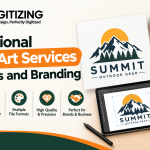
A professional logo should look clean and recognizable on everything from business cards to storefront signs. However, low-resolution images can become blurry when enlarged, making a brand appear inconsistent across different materials. At ZDigitizing, we help businesses prepare high-quality artwork through Custom vector artwork services that make logos and graphics easier to scale, edit, and prepare for production.
Our Vector Art Services focus on converting, recreating, and refining artwork for practical design applications. Whether you are building a new brand identity or updating an existing logo, understanding vector graphics can help you make better decisions about file quality, scalability, and consistency. This guide explains how vector artwork supports branding, which file formats matter, and what to consider before ordering a professional service.
What Are Professional Vector Art Services?
Vector Art Services involve creating or converting artwork into graphics built from mathematical paths, curves, points, and shapes rather than a fixed grid of pixels. This structure allows vector graphics to be resized without the pixelation associated with enlarging low-resolution images.
For branding, vector artwork is particularly useful because a logo may need to appear in many places, including:
- Business cards and stationery
- Websites and digital marketing materials
- Product labels and packaging
- Promotional merchandise and apparel
- Storefront signs and banners
- Printed brochures and advertisements
A properly prepared vector logo can maintain smooth outlines across different sizes. The design can also be edited more easily when a brand needs color adjustments, revised shapes, or updated layouts.
Why Does Vector Artwork Matter for Logo Design?
1. Keeps Logos Sharp at Any Size
A logo must remain recognizable whether it appears on a small product label or a large advertising banner. Vector graphics make this possible because their shapes are mathematically defined rather than limited to a specific pixel resolution.
For example, enlarging a small JPEG logo may reveal jagged edges around letters and symbols. A properly recreated vector version can preserve smoother outlines at larger dimensions.
Scalability does not automatically improve every design detail, though. If the original logo contains unclear text or inaccurate shapes, those elements may need to be corrected during the conversion process.
2. Creates Consistency Across Brand Materials
Strong branding depends on using the same visual identity across different customer touchpoints. Inconsistent logo proportions, colors, or lettering can make marketing materials look disconnected.
A vector master file provides a reusable source for creating different versions of a logo. Designers can adjust the artwork for various dimensions while maintaining its essential structure.
Our Custom vector artwork services can help prepare artwork for different uses, depending on the original design and the required output. Maintaining an organized master file also makes future revisions easier.
3. Makes Logo Editing More Practical
Businesses sometimes change their brand colors, update their typography, or simplify a logo for a new application. Vector artwork generally makes these changes easier because individual paths and shapes can be adjusted when the file is properly structured.
For instance, a designer may need to change a logo's color for a dark background or modify an element so it remains visible on a small label.
Editable vector artwork provides greater flexibility than a flattened image, although the specific editing options depend on the file format and how the artwork was created.
4. Supports Professional Printing and Production
Brand artwork is often used for screen printing, signage, vinyl cutting, packaging, and promotional products. Many of these applications benefit from clean outlines and well-defined shapes.
Vector files can be especially useful for vinyl cutting because the cutting software needs paths that define the shapes to follow. Screen printing may require separate color layers, while commercial printing may require a particular PDF or EPS setup.
The correct artwork must match the intended production method. File preparation, color settings, dimensions, and the printer's specifications remain important even when the design is vector-based.
Which Vector File Formats Should You Choose?
The best file format depends on how you plan to use your logo and which applications your designer or production provider supports.
|
Format |
Common branding application |
|
AI |
Editable artwork in Adobe Illustrator workflows |
|
EPS |
Vector artwork exchange and compatible production workflows |
|
SVG |
Websites, scalable graphics, and compatible cutting software |
|
|
Sharing artwork and supplying print documents when correctly exported |
|
WMF |
Vector graphics in compatible Windows applications |
|
EMF |
Graphics exchange with compatible Windows-based software |
Not every file with one of these extensions is guaranteed to contain editable vector paths. For example, a PDF may contain a raster image rather than true vector artwork.
At ZDigitizing, we offer vector artwork in formats including AI, EPS, PDF, SVG, WMF, and EMF, depending on the selected requirements. Before ordering, confirm which format your printer, designer, or production provider needs.
How to Prepare Your Logo for Vector Conversion
A successful conversion starts with clear instructions and the best available source artwork. Follow these steps before submitting your design.
Step 1: Provide the original artwork.
Send your highest-quality logo image or original design file. A clear PNG, JPEG, PDF, or editable source file can help the designer identify the intended shapes, text, and colors.
Step 2: Explain how you will use the logo.
Tell your designer whether the logo is intended for website graphics, business cards, packaging, apparel, signs, or promotional products. Different applications may require different file formats and design adjustments.
Step 3: Specify colors and design requirements.
Provide brand color references and explain which elements must remain unchanged. If the artwork includes small lettering, thin lines, or complex details, identify these features so they can receive appropriate attention.
Step 4: Request the necessary file formats.
Ask your designer to supply the formats required by your intended workflow. If you work with multiple vendors, you may need an editable master file and one or more production-ready exports.
Step 5: Review the final artwork.
Check spelling, letter shapes, proportions, colors, and alignment. Inspect the logo at both small and large sizes to make sure important details remain clear. Request corrections before approving the final version if anything differs from your original design.
Common Logo Vectorization Mistakes to Avoid
Even when a logo has been converted to vector format, poor preparation can affect its appearance or usability. Watch for these common problems:
- Relying entirely on automatic tracing: Automatic tools may produce excessive anchor points, uneven curves, or distorted lettering. Complex logos may need manual refinement.
- Ignoring small details: Thin lines, tiny text, and narrow spaces may become difficult to reproduce in certain printing applications.
- Using inconsistent colors: Different color values across logo versions can weaken brand consistency. Establish approved color references for your design.
- Choosing an unsuitable file format: A file that works for website graphics may not meet a printer's or cutting machine's requirements.
- Overcomplicating the logo: Unnecessary details can reduce legibility at small sizes. Simplification may be appropriate for certain applications, provided the brand identity remains recognizable.
Reviewing these details before production can reduce avoidable revisions and make the artwork more useful across different branding applications.
When Should You Hire a Professional Vector Artist?
Professional Vector Art Services are useful when you have a blurry logo, need a design enlarged, or want an editable version of existing artwork. They can also help when a business has an old logo image but no original vector file.
You may benefit from professional conversion if:
- Your logo looks pixelated when enlarged.
- A printer requests AI, EPS, SVG, or vector PDF artwork.
- You need to update logo colors or refine outlines.
- You want a reusable master file for multiple marketing materials.
- Your existing artwork needs cleanup before printing or production.
Our Custom vector artwork services are designed to support artwork conversion, logo refinement, and related vector preparation needs. The best approach depends on the complexity of your design, the quality of the source image, and the final application.
Before placing an order, provide your source artwork, explain the intended use, and identify the required output format. Clear requirements help establish what the project needs without making assumptions about the final result.
Give Your Brand Artwork a Stronger Foundation
Consistent branding begins with artwork that can be used reliably across different sizes and materials. Professional Vector Art Services make logos easier to scale and edit while helping preserve clean outlines for compatible design and production workflows.
At ZDigitizing, we help customers convert and refine artwork for their design requirements. If your logo is blurry, difficult to edit, or unsuitable for an upcoming print project, explore our vector art service and share your artwork and file requirements to determine the appropriate next step.
Frequently Asked Questions
1. Why should businesses use professional vector art services for logos?
Professional Vector Art Services help businesses create scalable logo artwork with clean outlines. A vector logo can be adapted for business cards, packaging, signage, and promotional materials without the pixelation associated with enlarging low-resolution images. Proper preparation also makes future editing and brand asset management more practical.
2. Can a PNG or JPEG logo be converted into a vector file?
Yes. A PNG or JPEG logo can often be converted through tracing or manual recreation. The best method depends on the image quality, logo complexity, and clarity of the original design. Complex shapes, small text, or blurry details may require manual refinement to create an accurate result.
3. Which file format is best for a professional logo?
There is no single best format for every use. AI and EPS are useful in compatible vector design workflows, SVG is commonly used for scalable web graphics, and PDF is widely used for sharing print documents. We recommend confirming your designer's or printer's requirements before choosing the final format.
4. Does vector artwork improve brand consistency?
Vector artwork can help maintain consistent logo proportions and outlines across different sizes and applications. A reusable master file also makes revisions more manageable. However, brand consistency still depends on using approved colors, correct logo variations, and clear guidelines across all marketing materials.
5. How do I prepare my logo before ordering vector art services?
Provide the clearest available image, explain where you plan to use the logo, specify your preferred colors, and identify the required file formats. Include any details that must remain unchanged. Reviewing the completed artwork for spelling, proportions, and visual accuracy before approving it can help prevent unnecessary production revisions.