

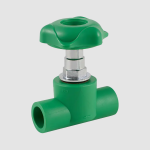



PPR Ball Valve and Globe Valve / Stop Valve are widely used in modern piping systems where operational clarity and control reliability are expected. Although they are often grouped under the same category of flow control components, their mechanical behaviors differ in ways that directly influence installation planning, daily operation, and system adjustment. These differences shape how each valve type contributes to overall system performance.
The PPR Ball Valve is frequently chosen for systems that require straightforward operation. Its quarter-turn mechanism allows users to open or close the valve with minimal effort, which can be valuable in residential buildings, commercial facilities, and service pipelines where quick response matters. This simple motion reduces the chance of partial opening, helping operators clearly identify the valve’s status during routine checks.
Material compatibility is another factor that supports the use of PPR Ball Valves in plastic piping networks. Since both the valve body and pipe share similar thermal expansion characteristics, sealing performance remains stable under temperature variation. This consistency is particularly useful in hot and cold water distribution systems, where repeated temperature changes can affect joint integrity over time.
Globe Valve / Stop Valve designs serve a different operational purpose. Instead of focusing on quick isolation, they allow gradual control over flow volume. The internal disc moves toward or away from the seat, enabling fine adjustments that are difficult to achieve with a ball valve. This capability supports applications where flow balance or pressure regulation is more important than rapid shutoff.
Because of their regulating function, globe valves are often placed in sections of the system where flow needs to be adjusted during commissioning or periodic tuning. Heating systems, circulation loops, and industrial pipelines commonly rely on this type of valve to manage flow distribution without introducing sudden changes. The controlled movement helps protect downstream components from pressure fluctuations.
In mixed piping systems, both valve types are often installed together rather than used as alternatives. A PPR Ball Valve may be positioned upstream to provide isolation during maintenance, while a Globe Valve / Stop Valve manages downstream flow regulation. This arrangement allows maintenance work to proceed without disturbing calibrated flow settings elsewhere in the system.
Operational wear patterns also differ between the two valve types. Ball valves typically experience limited friction during operation, as the sealing surfaces only engage fully at the closed position. Globe valves, however, involve continuous contact between internal components during throttling. Understanding these wear characteristics helps users plan inspection intervals and maintenance schedules more effectively.
Industry discussions around system efficiency increasingly emphasize proper valve placement. Instead of relying on a single valve type for all functions, designers now consider how each valve’s behavior affects long-term operation. Using a PPR Ball Valve strictly for isolation and a Globe Valve / Stop Valve for regulation aligns valve performance with system demands.
As piping systems grow more complex, valve selection becomes a strategic decision rather than a routine purchase. Both PPR Ball Valves and Globe Valve / Stop Valve units continue to be specified because their functions remain relevant across residential, commercial, and light industrial projects. Their coexistence reflects practical engineering choices shaped by real operating conditions.