





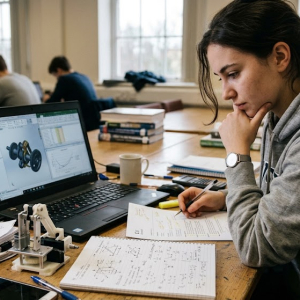

Picture this: it's week three of first year, you've just sat through a two-hour lecture on differential equations, and you haven't seen a single picture of a wing yet. You came here to study aircraft, not to relive A-Level maths. If that sounds familiar, you're not alone nearly every aeronautical engineering student in the UK has had this exact thought, usually around October of their first term. Stick with it, though, because the maths that felt pointless in September starts explaining, almost overnight, why a wing bends the way it does or why an engine behaves differently at altitude.
That moment matters more than it seems, because it changes how you need to study from that point onwards. Aeronautical engineering doesn't stay a collection of separate subjects for long. It shifts from learning individual tools a formula here, a principle there to using several at once, in the same problem, often under time pressure. By third or fourth year, you're expected to analyse a system, weigh up trade-offs, and make a judgement call about something where one decision ripples out and affects three others.
Where It Actually Starts
Most UK degrees follow a similar shape in the early years. You'll get a heavy dose of mathematics, mechanics, materials science, thermodynamics, fluid mechanics and programming before you spend serious time on full aircraft systems. It can feel like a long detour, especially when your first-year timetable has more Greek symbols than aeroplane diagrams on it. A friend studying at a Russell Group university once said her entire first term felt like "maths for the sake of maths," and she nearly switched courses over it.
There's a reason behind that ordering, even if it isn't obvious at the time. Aerodynamics is built directly on fluid mechanics; structural analysis leans on mechanics and materials; flight dynamics is practically drowning in mathematics. The degree is quietly stacking blocks in first and second year so that, later on, you can build something that actually flies on paper, in a simulation, or in a wind tunnel.
The Frustration Most Students Hit
A common complaint is judging a module purely by how obviously it connects to aircraft. Calculus, in particular, gets written off early "what has this got to do with aerospace?" because the lecture slides don't mention wings, engines or cockpits at all. That opinion tends to change fast once the problems stop being tidy. Try describing an aircraft whose speed, altitude and rotation are all changing at once, and suddenly that calculus module is doing very real, practical work.
The other frustration is that later problems refuse to sit neatly inside one subject. Take something as ordinary as a wing. Airflow determines how it performs, structural loads determine how it needs to be built, and material choice determines how much it weighs and how strong it is and all three factors argue with each other constantly. Change one, and you've quietly changed the other two as well.
The Concepts Doing the Heavy Lifting
Mathematics is the language underneath almost everything else on the course. Calculus and differential equations turn up constantly in dynamics, control theory and simulation work, while numerical methods step in once a problem gets too messy for pen-and-paper calculation. Mechanics tells you what forces are doing to a structure, and materials science answers the follow-up question how that structure actually responds. Add aerodynamics for airflow, and thermodynamics and propulsion for energy, and you've got most of the toolkit a working aerospace engineer relies on.
Computing then stops being a standalone module and becomes something closer to a shared language across every other subject. A simulation might model pressure distribution across a wing, or predict how a control system responds over several seconds of turbulence. The software will happily produce a graph either way accurate or not. It cannot tell you whether that graph makes physical sense; that judgement still sits with the engineer running it.
A Better Question to Ask
When a topic genuinely isn't landing, it's worth swapping the question you ask yourself. Instead of "what's new here that I don't understand," try "what earlier idea is this quietly relying on." Nine times out of ten, a structures problem that feels impossible traces back to a shaky grasp of basic mechanics from first year. A propulsion calculation that won't balance often needs a five-minute trip back to thermodynamics, not another hour hammering at the same equation. It's usually this the gap two steps back, not the question in front of you that sends students hunting for the best aeronautical engineering help UK has to offer, when what they actually needed was five minutes with last term's notes.
Your specific course matters here too, since not every UK programme moves at the same pace. Some universities introduce design projects and computational modules earlier than others, and a few lean harder into group coursework from year two onwards. The order shifts slightly between institutions, but the general direction stays the same everywhere: foundations first, integration later.
Turning This Into a Study Habit
Next time a flight-dynamics or structures problem refuses to click, resist the urge to just grind through ten more practice questions. Pull the problem apart instead separate out the mechanics, the maths, the assumptions you're making, and what the answer should physically mean. Whichever piece feels weakest is almost always where your revision needs to start, not the topic on this week's slide.
The same habit pays off in design projects. If you're assessing a wing for a coursework brief, don't stop at aerodynamic performance and call it done. Think through the structural loads it needs to survive, the material that's realistic for the budget, and the weight penalty and how nudging any one of those changes the other two. That's a far more honest picture of what engineering involves than any single-subject question ever gives you.
It's also worth building the habit of interrogating your own results before you trust them. Check the units. Ask whether the number you've landed on is remotely sensible for a real aircraft, and what would happen if one starting assumption was slightly wrong. A calculator will confirm a figure without hesitation; it has no idea whether that figure makes engineering sense, and neither will your marker if you can't explain it.
Bringing It Together
Aeronautical engineering never actually stops being about aircraft, even when the timetable suggests otherwise for a term or two. What changes, gradually and then all at once, is the altitude you're looking at them from. You spend the early years learning individual pieces maths, mechanics, materials, code almost in isolation. Later, you use all of them together to understand structures, flight behaviour, propulsion and design as one connected picture.
The real shift happens the day you stop asking "can I solve this" and start asking "why is this the right approach, and what does the answer tell me about the aircraft." Once that becomes automatic, the degree stops feeling like separate modules bolted together. It starts feeling like the thing you actually signed up for.