

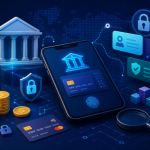


FinTech software has to do something ordinary software does not: handle financial information and transactions where mistakes can have real monetary and regulatory consequences. That makes FinTech software development more demanding than building a typical business application. Payment processing, data security, KYC, fraud prevention, third-party integrations, compliance, scalability, and transaction accuracy all need to work together.
The challenge is rarely the technology alone. A technically sound application can still fail if its transaction flows are poorly designed, compliance requirements are considered too late, or the system cannot recover cleanly from a failed payment. The practical approach is to identify these risks early and design the product around them.
What Is FinTech Software Development?
FinTech software development involves creating digital products that support financial activities through software and connected services. These products can include:
- Payment and money-transfer platforms
- Digital wallets
- Banking applications
- Lending platforms
- Investment and wealth-management software
- Insurance technology
- Financial management applications
- Crowdfunding platforms
- Financial APIs
- Fraud detection systems
Unlike a standard application, a FinTech product often depends on external financial institutions, payment providers, identity-verification services, regulatory requirements, and sensitive customer data.
A typical application might be able to treat a failed API request as a technical error. A financial application may need to determine whether the transaction was actually processed before deciding what to show the user or whether a retry is safe.
That difference shapes almost every part of the development process.
8 Common FinTech Software Development Challenges
1. Meeting Security Requirements
Security is one of the first challenges because FinTech applications handle information that attackers actively target.
A financial application may contain personal information, account details, payment information, transaction records, and authentication credentials. A security weakness can therefore create financial losses as well as reputational and regulatory problems.
Common security measures include:
- Multi-factor authentication
- Encryption in transit and at rest
- Role-based access controls
- Secure API authentication
- Device verification
- Rate limiting
- Audit logging
- Vulnerability testing
- Secure secrets management
Security should be built into the architecture instead of being treated as a final testing stage.
A useful starting point is to identify the most sensitive actions in the product. Logging into an account, adding a new payment method, changing account details, and sending a large payment may require different levels of protection.
2. Managing KYC and Identity Verification
Financial products often need to establish who their users are.
Depending on the business model and jurisdiction, KYC processes may involve identity documents, address information, biometric checks, sanctions screening, and ongoing monitoring.
The technical challenge is making verification part of the user journey without creating unnecessary friction.
For example, the application may need different account states:
Unverified → Verification in progress → Verified → Additional review required → Restricted
Those states can then determine which features the user can access.
Using a specialist provider for identity verification can reduce the amount of infrastructure that needs to be built internally, but the integration still needs to handle failed checks, incomplete documents, manual reviews, provider outages, and status updates.
3. Handling Fraud and Suspicious Transactions
Fraud prevention cannot rely on login security alone.
A legitimate account can be compromised, or a genuine user can behave in a way that appears unusual. FinTech software therefore needs transaction-level controls.
Risk systems can evaluate signals such as:
- Transaction amount
- Transaction frequency
- New recipients
- New devices
- Login behaviour
- Geographic inconsistencies
- Previous transaction patterns
- Failed authentication attempts
A rules-based system can catch clearly defined conditions, while machine-learning models can help identify less obvious patterns.
The important part is what happens after a transaction is flagged. The system may need to block the payment, request additional verification, place it under review, or allow it to continue with enhanced monitoring.
This is where AI development services can be relevant for use cases such as anomaly detection, predictive models, and fraud analysis.
4. Integrating Banks and Financial APIs
Few modern FinTech applications operate in isolation.
A product may need to connect with payment gateways, banks, Open Banking providers, KYC platforms, fraud services, card networks, accounting systems, and communication tools.
Each integration introduces another dependency.
The provider may experience downtime. An API response may be delayed. A webhook may arrive later than expected. An API version may change.
The solution is to build an integration layer rather than scattering provider-specific logic throughout the application.
The integration architecture should account for:
- API authentication
- Webhooks
- Retries
- Timeouts
- Idempotency
- Error handling
- Provider status mapping
- Logging
- Monitoring
Idempotency is particularly important for payments. If a request is retried after a network interruption, the system should be able to recognise that it is the same transaction rather than creating another one.
FinTech API development can be used to build and connect financial APIs, payment services, identity systems, and other third-party financial infrastructure.
5. Maintaining Accurate Financial Records
A payment system needs more than a database field called "balance."
If a customer has $1,000 and sends $250, the system needs a reliable record of the transaction and its effect on the account.
This is where a financial ledger becomes important.
A simplified example is:
Opening balance: $1,000
Payment: -$250
Closing balance: $750
The system should retain the underlying transaction rather than simply replacing the previous balance with a new number.
A proper transaction model also needs to support states such as:
- Initiated
- Pending
- Processing
- Completed
- Failed
- Reversed
- Refunded
This becomes especially important when the application relies on external payment providers.
6. Reconciliation Between Systems
Reconciliation is closely related to transaction accuracy but deserves separate attention.
Imagine an application records a $500 payment as submitted, while the payment provider later reports that the transaction failed.
If the two systems are not reconciled, the application's records may show something different from the actual financial outcome.
A reconciliation process compares internal records with external provider records and identifies discrepancies for automated or manual resolution.
This becomes increasingly important as transaction volumes grow.
It is also one of the areas that should be considered early in custom software development because changing financial data structures after launch can be considerably more difficult than designing them correctly from the start.
7. Meeting Different Regulatory Requirements
FinTech regulation is not identical across countries.
A product operating in the United States may need to assess requirements involving FinCEN, BSA/AML, OFAC, EFTA/Regulation E, state money-transmission laws, and other applicable rules.
A UK product may need to consider FCA requirements and the Payment Services Regulations. A European product can have requirements involving PSD2, Strong Customer Authentication, GDPR, and AML rules. Canada, Australia, UAE, Singapore, and other markets have their own regulatory frameworks.
The important point is that the applicable requirements depend on the actual business model.
A company should determine:
- Where customers are located
- Whether customer funds are held
- Which payment services are provided
- Which entities process the transactions
- Which financial partners are involved
- What personal and financial information is collected
Compliance requirements should then be translated into actual product requirements.
For example, an applicable transaction-monitoring requirement may mean the platform needs event logging, risk rules, alerts, investigation tools, and appropriate reporting capabilities.
8. Scaling Without Losing Reliability
A FinTech application may start with a relatively small user base and later process a much larger number of transactions.
Scaling is not simply about adding more servers.
The system needs to maintain transaction consistency while handling increased demand.
Important areas include:
- Database performance
- API capacity
- Queue management
- Caching where appropriate
- Background processing
- Monitoring
- Load balancing
- Disaster recovery
- Backup strategies
Cloud infrastructure can help applications scale, but financial workloads still need careful architecture.
A sudden increase in transaction volume should not result in duplicate payments, lost events, inconsistent balances, or delayed reconciliation.
A Practical Approach to FinTech Software Development
The best way to manage these challenges is to address them during planning rather than after development.
Start With the Financial Workflow
Define how money enters the system, moves between accounts, reaches the recipient, and gets settled.
Then document what happens if the payment fails.
Define the Compliance Scope
Identify the target markets and determine which regulations actually apply.
Do this before finalising onboarding, transaction limits, data storage, and payment architecture.
Build the Core Transaction System Carefully
The ledger, transaction engine, payment integration layer, and reconciliation process deserve particular attention.
They form the foundation for the rest of the product.
Keep External Integrations Replaceable
Payment and financial providers can change.
An abstraction layer can prevent the rest of the application from becoming tightly dependent on one provider's API structure.
Test Failure Scenarios
Testing should include more than successful transactions.
Test:
- Duplicate requests
- Provider timeouts
- Delayed webhooks
- Failed payments
- Reversals
- Refunds
- Unauthorised transactions
- Suspicious activity
- Account recovery
- Service outages
A reliable FinTech application is defined partly by how it behaves when something goes wrong.
Choosing the Right Technology Approach
The technology stack should follow the product requirements.
For mobile products, Flutter, React Native, Swift, and Kotlin are common choices. Backend systems can be developed with technologies such as Node.js, Python, Java, or .NET.
The database, cloud environment, API architecture, monitoring tools, and security controls should be selected around transaction volume, integrations, performance, and long-term maintenance.
For businesses building financial products, mobile app development can cover the customer-facing application, while backend and integration work supports the financial workflows behind it.
For larger platforms, SaaS product development can also be relevant where the product needs multi-tenancy, shared infrastructure, user management, APIs, and cloud-based operations.
Final Thoughts on FinTech Software Development
Successful FinTech software is built around accuracy, security, reliability, and clear financial workflows. The biggest challenges are rarely solved by adding more features. They are solved by understanding how transactions work, planning for failure, integrating external financial services properly, and translating regulatory requirements into practical technical controls.
Start with the financial model and target markets. Define the core transaction journey, build the ledger and integration architecture carefully, and test the situations where payments fail or require review.
Nyusoft provides FinTech application development alongside custom software, mobile, AI, API, SaaS, cloud, and DevOps capabilities for businesses developing financial and other digital products.