



Introduction
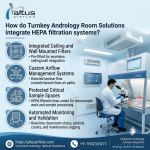
Altus Airflow provides specialized modular infrastructure solutions for fertility clinics and reproductive healthcare facilities. Turnkey Andrology Room Solutions integrate HEPA filtration systems to maintain controlled air quality, reduce airborne particulate contamination, and support hygienic laboratory environments. These systems are designed by coordinating HVAC equipment, filtration units, air distribution arrangements, pressure controls, and environmental monitoring technologies. Proper integration helps create suitable conditions for semen analysis, sperm preparation, and other andrology laboratory procedures where cleanliness and environmental stability are important.
A well-planned filtration system also supports contamination control, equipment protection, and consistent laboratory operations.
1. Understanding the Importance of HEPA Filtration in Andrology Rooms
Andrology laboratories perform specialized procedures involving semen analysis, sperm processing, sample preparation, and fertility-related investigations. These activities require carefully controlled laboratory environments.
Airborne particles, dust, and other contaminants can affect laboratory cleanliness and may create challenges for sensitive procedures.
High-Efficiency Particulate Air (HEPA) filters are designed to remove at least 99.97% of particles measuring 0.3 micrometres under the commonly referenced US HEPA test standard. Their actual performance depends on filter specifications, installation quality, sealing, and operating conditions.
HEPA filtration helps by:
-
Reducing airborne particulate matter.
-
Supporting controlled laboratory cleanliness.
-
Limiting the circulation of airborne contaminants.
-
Protecting sensitive laboratory equipment.
-
Supporting consistent environmental conditions.
-
Complementing established laboratory hygiene practices.
However, HEPA filtration alone does not guarantee sterility or prevent every form of contamination. It must be combined with appropriate cleaning procedures, personnel practices, ventilation design, and laboratory protocols.
2. Conducting an Initial Laboratory Assessment
Before integrating HEPA filtration, engineers must understand the laboratory's layout, operational requirements, and existing ventilation infrastructure.
An initial assessment helps determine the filtration capacity, equipment arrangement, and air distribution requirements.
Important assessment activities include:
Room size evaluation: Engineers measure the room dimensions to estimate the required airflow volume and suitable filtration arrangements.
Laboratory activity assessment: The type of procedures performed helps determine environmental cleanliness requirements.
Existing HVAC inspection: Existing air handling units, ductwork, ventilation capacity, and filtration arrangements are evaluated.
Equipment identification: Microscopes, biological safety cabinets, centrifuges, workstations, and other laboratory equipment are considered during planning.
Airflow requirement analysis: Engineers determine suitable air supply and return arrangements based on the room's intended function.
This assessment provides the foundation for selecting appropriate filtration equipment and developing an integrated laboratory ventilation design.
3. Selecting the Appropriate HEPA Filtration System
HEPA filter selection is an important part of laboratory engineering because different spaces may require different filtration arrangements.
The filter should be selected according to the room classification, required air cleanliness, airflow volume, equipment specifications, and applicable standards.
Common considerations include:
-
Filtration efficiency.
-
Filter dimensions.
-
Airflow capacity.
-
Initial and final pressure drop.
-
Housing compatibility.
-
Gasket and sealing arrangements.
-
Maintenance accessibility.
-
Testing and certification requirements.
Common HEPA filter classifications include H13 and H14 under EN 1822 and ISO 29463 classification frameworks.
The appropriate filter grade should be determined through project-specific engineering rather than selecting the highest available grade without considering the complete ventilation design.
Correct filter selection helps maintain the intended air quality while avoiding unnecessary resistance to airflow.
4. Integrating HEPA Filters with HVAC Systems
HVAC integration is one of the most important stages of HEPA filtration installation.
A properly designed HVAC system distributes filtered air throughout the andrology room while maintaining the required environmental conditions.
HEPA filters may be installed in suitable terminal filter housings or within appropriately designed air handling configurations.
The integration process generally includes the following activities.
Air handling unit coordination: Engineers evaluate the AHU capacity to ensure that it can deliver the required airflow through the selected filters.
Ductwork arrangement: Ducts are designed to distribute air efficiently without creating unnecessary pressure losses.
Filter housing installation: Suitable housings are installed to support correct filter positioning and sealing.
Air supply positioning: Supply diffusers are placed according to the laboratory layout and intended airflow pattern.
Return air planning: Return air grilles are positioned to support effective air circulation.
System balancing: Airflow is adjusted and measured to achieve the approved design requirements.
These activities help ensure that the filtration system functions as part of an integrated ventilation arrangement rather than as an isolated component.
5. Designing Proper Airflow Distribution
HEPA filtration is effective only when filtered air is distributed appropriately throughout the laboratory.
Poor airflow distribution may create stagnant zones, uneven air circulation, or unwanted turbulence.
Therefore, engineers evaluate the positions of air supply diffusers, return grilles, laboratory workstations, and equipment.
Important airflow considerations include:
Air supply direction: Filtered air should enter the room through appropriately positioned supply outlets.
Return air positioning: Return grilles should support the intended circulation pattern.
Equipment placement: Large equipment should not unnecessarily obstruct airflow pathways.
Personnel movement: The movement of laboratory personnel should be considered when designing air distribution.
Dead zones: Layout planning should minimize areas where air circulation is inadequate.
Depending on the laboratory's design requirements, airflow visualization studies may be conducted to assess the movement of air.
This helps identify potential airflow disturbances and supports adjustments to diffuser placement and ventilation arrangements.
6. Maintaining Suitable Pressure Differentials
Pressure differential control is another important element of HEPA filtration integration.
Andrology laboratories may require specific pressure relationships with adjacent rooms depending on their function and contamination-control strategy.
Pressure sensors help monitor these relationships and provide information about changes in room pressure.
Depending on the approved design, pressure monitoring may include:
-
Digital differential pressure sensors.
-
Pressure display panels.
-
Configurable alarm systems.
-
HVAC control integration.
-
Continuous pressure monitoring.
-
Historical data recording.
Positive pressure may be used in certain clean environments to reduce the entry of less-clean air from surrounding spaces.
However, pressure requirements should be determined through a room-by-room contamination-control assessment. Not every andrology room requires identical pressure conditions.
Proper door sealing, ventilation balancing, and controlled access also contribute to maintaining the intended pressure relationships.
7. Integrating Temperature and Humidity Monitoring
Environmental stability is important for andrology laboratory operations.
Temperature and humidity can influence laboratory comfort, equipment performance, and the operating conditions required by specific procedures.
HEPA filtration systems are generally integrated with HVAC arrangements that also regulate these environmental parameters.
Digital monitoring systems may include:
Temperature sensors: These continuously measure room temperature.
Humidity sensors: These provide information about moisture levels.
Digital displays: Environmental readings can be viewed through monitoring panels.
Alarm notifications: Alerts can be configured when readings move outside approved limits.
Data recording: Some systems maintain historical environmental records.
These monitoring features help laboratory personnel identify environmental deviations and coordinate corrective action.
The required temperature and humidity ranges should be established according to equipment manufacturer recommendations, laboratory procedures, and applicable guidelines.
8. Installing Properly Sealed Modular Infrastructure
The effectiveness of HEPA filtration depends not only on filter quality but also on the condition of the surrounding room infrastructure.
Air leakage through poorly sealed joints, gaps, doors, or service penetrations can affect the intended airflow and pressure conditions.
Modular laboratory interiors help engineers coordinate filtration infrastructure with the room's architectural components.
Important features may include:
-
Smooth, easy-to-clean wall panels.
-
Properly sealed panel joints.
-
Suitable ceiling systems.
-
Controlled door arrangements.
-
Sealed utility penetrations.
-
Appropriate flooring finishes.
-
Accessible maintenance panels.
Filter housings should also be installed with suitable gaskets and sealing arrangements.
These measures help reduce uncontrolled air leakage and support the intended ventilation performance.
9. Integrating HEPA Filtration with Laboratory Equipment
Andrology laboratories contain specialized equipment that must be considered during filtration and airflow planning.
Equipment placement can influence airflow distribution, access, cleaning, and the movement of laboratory personnel.
Common equipment includes:
-
Biological safety cabinets.
-
Microscopes.
-
Centrifuges.
-
Semen analysis systems.
-
Sample preparation workstations.
-
Refrigeration equipment.
-
Laboratory storage units.
Engineers should coordinate the room ventilation design with the equipment layout.
For example, a biological safety cabinet has its own specific airflow and containment requirements. It should not be treated as a substitute for room HEPA filtration.
Its exhaust and airflow arrangements must be evaluated according to the manufacturer's specifications and applicable safety requirements.
Proper coordination helps prevent conflicts between room ventilation, equipment airflow, and laboratory procedures.
10. Automation and Digital Monitoring of Filtration Systems
Modern laboratory infrastructure can incorporate automation features to simplify environmental monitoring and maintenance.
Digital control systems provide useful information about the operating condition of selected filtration and ventilation components.
Possible automation features include:
- Filter differential pressure monitoring: Sensors identify changes in pressure across the filter.
- Airflow monitoring: Compatible instruments provide information about ventilation performance.
- HVAC status monitoring: Control panels display selected operating conditions of air handling equipment.
- Environmental alarms: Alerts indicate temperature, humidity, or pressure deviations.
- Centralized monitoring: Compatible systems can communicate with a Building Management System.
- Historical data recording: Digital records help facility teams review system performance over time.
These features support preventive maintenance and help identify potential issues.
However, differential pressure readings cannot independently confirm filter integrity. Appropriate integrity testing remains necessary.
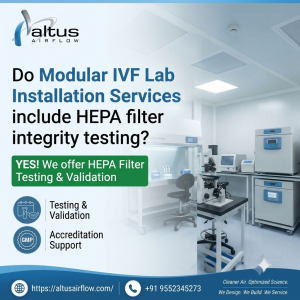
11. HEPA Filter Integrity Testing and Commissioning
Testing and commissioning are essential before an andrology laboratory begins routine operations.
Even a high-quality HEPA filter may not perform as intended if it is damaged, improperly installed, or inadequately sealed.
Therefore, appropriate testing should be conducted after installation.
Important activities include:
- Visual inspection: Checking filter housing, mounting arrangements, gaskets, and visible installation defects.
- Airflow measurement: Verifying that the system delivers the required airflow.
- Filter integrity testing: Conducting an appropriate aerosol-based leak test to identify defects in the filter media or sealing arrangements.
- Pressure differential measurement: Checking pressure relationships between the laboratory and adjoining spaces.
- Environmental testing: Measuring temperature and humidity according to the approved design.
- Airflow visualization: Where required, evaluating airflow direction and distribution.
- Documentation: Recording test results and commissioning observations.
Testing should follow the relevant filter classification, project specifications, and applicable standards.
These activities help confirm that the installed filtration system meets its intended performance requirements.
12. Maintenance of HEPA Filtration Systems
Regular maintenance is necessary to preserve filtration performance and ventilation reliability.
Over time, filters may accumulate particulate matter, increasing resistance to airflow.
A structured maintenance programme helps identify when inspection, testing, or replacement is required.
Important maintenance activities include:
-
Monitoring filter differential pressure.
-
Inspecting filter housings and sealing arrangements.
-
Checking airflow performance.
-
Conducting periodic integrity testing.
-
Inspecting HVAC fans and motors.
-
Cleaning ventilation components as specified.
-
Replacing filters according to approved criteria.
-
Maintaining inspection and replacement records.
Filter replacement should be based on manufacturer recommendations, measured performance, and applicable project requirements rather than an assumed universal replacement interval.
Maintenance activities should be performed by trained personnel using suitable procedures to avoid damaging the filtration system or contaminating the laboratory.
13. Benefits of Integrated HEPA Filtration in Andrology Laboratories
Integrating HEPA filtration into a properly engineered laboratory environment offers several benefits.
Improved airborne particle control: HEPA filters reduce the concentration of airborne particulate matter when correctly installed and maintained.
Better environmental management: Integrated HVAC systems help regulate airflow, temperature, and humidity.
Support for laboratory cleanliness: Controlled ventilation complements established cleaning and hygiene procedures.
Equipment protection: Reduced airborne dust can help protect sensitive laboratory equipment.
Improved monitoring: Digital sensors and control panels provide useful information about environmental conditions.
Maintenance planning: Differential pressure monitoring and inspection records help support timely maintenance.
Consistent laboratory operations: Proper engineering helps maintain the intended environmental conditions for routine laboratory activities.
These benefits make filtration planning an important part of modern fertility laboratory infrastructure.
Conclusion
Turnkey Andrology Room Solutions integrate HEPA filtration systems through coordinated HVAC design, suitable filter selection, controlled airflow distribution, pressure differential monitoring, modular interiors, and systematic commissioning. Proper installation and regular maintenance help maintain filtration performance and support controlled laboratory environments. Hospitals and fertility clinics should evaluate filtration requirements according to laboratory activities, equipment specifications, and applicable cleanliness standards.
Altus Airflow focuses on specialized modular healthcare and fertility laboratory infrastructure solutions. Through coordinated ventilation planning, modular installation, and technical system integration, Altus Airflow helps fertility facilities develop organized, hygienic, and functionally designed andrology laboratories.
Frequently Asked Questions (FAQs)
1. How do Turnkey Andrology Room Solutions integrate HEPA filtration systems?
Turnkey Andrology Room Solutions integrate HEPA filtration through HVAC systems, filter housings, controlled airflow distribution, pressure monitoring, and environmental testing.
2. Why are HEPA filters important in andrology laboratories?
They help reduce airborne particulate contamination and support controlled laboratory cleanliness.
3. Which HEPA filter grades are used in andrology rooms?
H13 and H14 filters may be used depending on the required cleanliness level and engineering specifications.
4. Does HEPA filtration control laboratory temperature?
No, HEPA filters remove airborne particles. Temperature is regulated through the integrated HVAC system.
5. Is pressure monitoring necessary in andrology laboratories?
It is necessary when specified by the laboratory's contamination-control and ventilation design.
Read Our Previous Blog ---------------> How does a Modular Cardiac OT Engineering Company optimize OT workflow?