

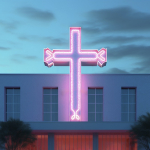

You've probably stood outside a church at some point and squinted at a sign that says "SUN AY SERV CE 10 AM" because half the letters fell off, or nobody's gotten around to updating it since Easter. This thing is common and happens almost everywhere. Nobody's blaming the volunteer who forgot to change the letters on the church sign last Tuesday. It happens.
But that little plastic-letter board may not be doing nearly as much for your church as you think. It shares the basics, sure, but it can't show a video, promote an upcoming event, welcome first-time visitors, or change a message in seconds.
And while a traditional sign doesn't come with a monthly invoice, it still costs money to keep it updated, relevant, and useful.
So, what can a video wall actually do that a traditional church sign can't?
Church Sign Board vs. LED Wall: Which Communicates More?
Can you think about the last time you drove past a church sign? Did you actually stop and read it, or did your eyes just slide right past it? You have to be true to yourself here.
That's the problem with static signs: they're wallpaper. Your brain stops registering them after the third drive-by. A video wall for church, though, moves. It changes; it catches your eye the same way a passing car's brake lights do, almost instinctively.
You're not just updating a message when you switch to a video wall. You're changing how people relate to your church before they even walk through the door. And that's a bigger shift than most people expect.
Where a Video Wall Actually Pulls Ahead
You Can Change the Message in Seconds, Not Sundays
With a letter board, someone has to climb up, dig through a box of plastic characters, and hope none are missing. It's a whole production for something as simple as announcing a potluck.
With a video wall, you type it, hit send, and it's live. Announce a last-minute prayer meeting at 9 PM for a 9:15 service. Swap the sermon title the morning of. Nobody's standing on a ladder in the rain trying to fit "REVIVAL NIGHT" into a space built for eight characters.
Your Livestream Finally Looks Like It Belongs on Screen
Here's something most churches don't think about until it bites them: your sanctuary's lighting matters more for video than you'd guess. A projector needs the room dimmed to look decent, which means your livestream picks up a dim, shadowy sanctuary that looks nothing like the warm space people remember.
An LED wall doesn't need the lights down. It's bright enough to hold its own under full-house lighting, so your online congregation sees a sanctuary that looks alive, not a room lit like a basement screening.
One Screen, a Dozen Jobs
A traditional sign does one thing: it displays words someone physically placed there. A video wall church does scripture during the message, lyrics during worship, a livestream feed for the folks in the overflow room, and a giving reminder during announcements, all without anyone touching a single letter.
- Scripture verses that scroll in sync with the sermon
- Song lyrics people can actually read from the back row
- Photos or video from last week's youth event, playing on loop before service starts
That's not a sign anymore. That's closer to how your church actually communicates.
But Isn't a Sign Just... Simpler?
This is a fair question, and sure, a sign doesn't need Wi-Fi or a tech volunteer who knows what HDMI stands for.
But "simpler" isn't the same as "better for your congregation." A sign that's simple to maintain is also simple to ignore, leave outdated, and lose to weather damage after one bad storm. You're trading a little bit of setup effort now for years of someone constantly fixing, updating, and squinting at faded letters later.
Where Church LED Walls Make a Difference
Picture your sanctuary on a bright Sunday morning. Sunlight's pouring through the windows, gorgeous for the room, brutal for a projector screen, which washes out to a pale, half-visible rectangle. An LED video wall doesn't flinch. It stays crisp, colours intact, readable from the very last pew.
Using Digital Church Sign Boards for Multiple Announcements
Or think about your custom outdoor signs during a week when three things are happening, a food drive Tuesday, choir practice Thursday, and a guest speaker Sunday. A letter board forces you to pick one. A digital display just rotates through all three, so nobody misses the announcement that actually matters to them.
Creating a More Welcoming Church Entrance
And picture a visitor pulling into the parking lot for the first time, nervous, not sure they're even at the right building. A warm, welcoming message on a bright screen — "You're welcome here"-- reads completely different than a static sign with last month's sermon title still hanging on it.
What's the Real Cost of Sticking With What You Have?
Ask yourself – how many people have driven past your church this month and never even glanced at the sign? How much time has a volunteer spent this year climbing a ladder to swap out letters for a message that changed the very next week anyway?
That's the honest math behind this decision. It's not really about "old vs. new." It's about whether your church's first impression- the one thing everyone drives by sees, whether they walk in or not- is actually working for you.
Where to Go From Here
You don't have to rip out your existing sign tomorrow. Plenty of churches start with one video wall inside the sanctuary, see how much easier Sunday mornings get, and expand from there. Others start outside, where visibility matters most, and the return is the most obvious.
Either way, the question worth sitting with is simple: is your current sign actually reaching people, or is it just... there?
Frequently Asked Questions
How much does a church video wall actually cost compared to a traditional sign?
Upfront, a video wall costs more than a plastic-letter board; that part's true. But a letter sign racks up hidden costs over time: replacement letters, ladder repairs, and someone's Sunday afternoon spent fixing it after a windstorm. Most churches find the video wall pays for itself in saved labour and fewer "who broke the sign" moments within a few years.
How long does installation take, and does it disrupt services?
Most installations take a few days to a couple of weeks, depending on whether it's a simple panel swap or a full structural mount. Reputable installers schedule around your service times, so Sunday morning isn't the day cables are hanging out of the wall.
Does a video wall need a dedicated tech volunteer to run it?
Not really; that's a common worry, but most modern systems run on simple software anyone comfortable with a tablet can pick up. You'll want one or two people who know the basics, the same way you'd want someone who knows how to work the soundboard.