

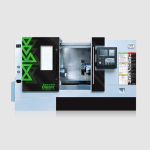

A busy machining workshop has plenty going on. Metal chips fall from the cutting area, tools move between operations, and unfinished components wait for their turn at the spindle. In this setting, a CNC Slant Bed Lathe offers a practical arrangement for turning metal parts through programmed movements and coordinated cutting operations.
Its defining feature is the inclined bed. Rather than placing the main guideways on a flat horizontal surface, the machine uses a sloped structure to support key moving components. This layout affects the position of the turret, spindle, and working area. It can also help chips slide toward the collection zone under gravity, depending on the machine design.
A CNC Slant Bed Lathe is suitable for producing shafts, sleeves, threaded fittings, and other cylindrical components. During machining, the spindle rotates the workpiece while the cutting tool follows a programmed path. Facing, external turning, grooving, and threading can be performed according to the selected tools and machining sequence.
The inclined structure is only one part of the machine's performance. Bed rigidity, guideway design, spindle capability, and turret positioning also influence cutting stability and dimensional accuracy. When machining steel or other demanding materials, the machine must resist cutting forces and keep the tool aligned with the workpiece.
Different production jobs may call for different machine configurations. A standard turning setup can handle common cylindrical profiles, whereas models equipped with live tooling or a Y-axis can perform additional operations on compatible components. A sub-spindle may also allow certain parts to be transferred for further machining without requiring a separate manual setup.
Before selecting a CNC Slant Bed Lathe, manufacturers should examine workpiece diameter, machining length, material type, and drawing requirements. Production volume and the number of required operations also affect the decision. A machine suited to short fittings may not accommodate a long shaft or a component requiring several machining stages.