


Rising Electricity Costs Are Putting Pressure on Factory Profits
For factory owners and operations managers, electricity is more than a monthly bill. It is an essential expense that keeps production lines, motors, compressors, lighting, and cooling systems running. When electricity costs rise, maintaining healthy profit margins becomes increasingly difficult.
Yet many factories have an opportunity to reduce a portion of these expenses by generating electricity on their own rooftops.
Commercial solar for factories allows manufacturers to use sunlight to generate electricity during the day, when many industrial facilities are actively operating. Instead of purchasing all their power from the grid, businesses can use solar-generated electricity to meet part of their daily demand.
According to the International Renewable Energy Agency (IRENA), the global weighted-average levelized cost of electricity from newly commissioned utility-scale solar photovoltaic projects was approximately $0.043 per kWh in 2024. This was 41% lower than the cost of the cheapest new fossil-fuel alternative. These figures relate to utility-scale projects, not individual factory installations, but they demonstrate the growing cost competitiveness of solar technology.
For factories in Kaithal, Haryana, and across India, commercial rooftop solar deserves consideration as a potential long-term energy cost management strategy.
1. Why Factories Should Rethink Their Energy Expenses
Manufacturing businesses must balance production targets, operating costs, and customer expectations. Electricity expenses can make this balance more challenging, particularly for facilities that operate machinery for long hours.
The difficulty is that conventional grid electricity remains a significant recurring expense. Even when production efficiency improves, higher energy costs can affect the savings achieved elsewhere.
Commercial solar offers a practical alternative by generating electricity at the point of consumption.
For example, a factory that operates primarily during daylight hours may be able to use a substantial portion of its solar generation immediately. This reduces the amount of electricity it needs to purchase from the grid while the system is producing power.
However, the actual benefit depends on factors such as factory operating hours, available rooftop space, electricity tariffs, seasonal sunlight, and the size of the proposed solar system.
The key question is simple: How much of your factory's daytime electricity demand could be met by solar power?
2. Five Ways Commercial Solar Can Benefit Factories
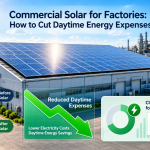
Reduce daytime electricity expenses
One of the main advantages of commercial solar is the opportunity to replace some purchased electricity with on-site generation.
Consider a hypothetical factory with a 200 kW rooftop solar system that generates an average of 800 units per day. If the factory uses 90% of that electricity directly and its avoided grid electricity cost is ₹8 per unit, the potential gross savings would be:
- Daily electricity cost avoided: ₹5,760
- Gross savings over 300 equivalent operating days: ₹17.28 lakh annually
These figures are illustrative, not a guaranteed estimate. Actual results depend on generation, consumption patterns, tariffs, system performance, and operating expenses. A project assessment should use the factory's actual electricity bills and site conditions.
Improve long-term energy cost planning
Electricity tariffs and other charges can change over time. Generating a portion of electricity on-site can help businesses reduce their exposure to some grid electricity costs.
Solar panels also provide an opportunity to estimate future generation and associated expenses over the system's operating life. While output varies with weather and equipment performance, this information can support better budgeting and investment decisions.
Make productive use of rooftop space
Large factory buildings often have substantial roof areas that may be suitable for solar panels. Using this space can allow businesses to generate electricity without acquiring additional land.
Before installation, however, the roof must be assessed for structural strength, shading, waterproofing, access, and safety. A suitable design should also account for electrical infrastructure and maintenance requirements.
Support more efficient energy management
Solar generation can complement daytime production schedules. Factories with substantial daytime electricity demand may benefit from using solar power directly rather than exporting surplus electricity at a potentially different rate.
Grid-connected solar does not automatically provide backup during a power outage. Factories requiring backup should separately assess battery storage, suitable inverters, and approved electrical arrangements.
Strengthen environmental performance
Solar electricity can reduce reliance on grid power and help lower a factory's operational carbon emissions. The amount of emissions avoided depends on the electricity generated and the emissions associated with the grid electricity displaced.
For manufacturers working towards sustainability targets or responding to customer environmental requirements, tracking solar generation and estimated emissions reductions can provide useful supporting data.
3. Is Commercial Solar a Worthwhile Investment for Your Factory?
The value of commercial solar depends on more than the number of panels installed. A financially sound project must match the factory's energy consumption, available space, and operating schedule.
Before making a decision, evaluate these three important factors.
Payback period: Estimate how long it may take for accumulated net savings to recover the initial investment. The calculation should account for maintenance, financing costs, applicable charges, and other relevant expenses.
Daytime electricity consumption: A factory that consumes most of its electricity while solar panels are generating power may use more of its solar electricity directly. Facilities operating mainly at night may require a different system design or storage strategy.
Project ownership and financing: Purchasing a system outright provides ownership but requires upfront capital. Financing may spread the cost over time, while a Power Purchase Agreement (PPA), where available, may allow a factory to buy solar electricity without owning the installation.
Each option has different financial implications, contractual obligations, and risks. Comparing them carefully can help decision-makers identify an arrangement suited to their business.
Rather than relying on a general industry estimate, request a site-specific assessment and a transparent financial projection before committing to a project.
4. Practical Steps to Introduce Solar in Your Factory
Factory managers can make the process more straightforward by following a structured approach.
Step 1: Review electricity bills. Collect 12 months of bills and examine consumption, tariff rates, demand charges, sanctioned load, and any time-of-day pricing.
Step 2: Understand your production schedule. Identify when electricity demand is highest and compare it with the expected hours of solar generation.
Step 3: Assess the rooftop. Check available space, structural capacity, shading, roof condition, and electrical safety requirements.
Step 4: Compare quotations. Evaluate system capacity, equipment quality, installation scope, warranties, maintenance arrangements, and expected performance.
Step 5: Check regulations and incentives. Confirm applicable grid-connection rules, metering requirements, electricity charges, and any available incentives under current regulations. Do not assume residential solar subsidies automatically apply to industrial installations.
Step 6: Monitor actual performance. After commissioning, compare solar generation and grid electricity purchases against the original estimates. Regular monitoring helps identify performance issues and supports realistic savings calculations.
A useful starting point is to calculate annual avoided grid electricity costs, add any eligible export revenue, and subtract operating expenses. The investment analysis should then consider the upfront cost and financing arrangements to determine whether the project meets your financial objectives.
5. Explore Commercial Solar Solutions with Solar 365
For factory owners in Kaithal, Haryana, and nearby industrial areas, the first step towards reducing daytime energy expenses is understanding how solar could fit into existing operations.
Solar 365 provides solar-related services covering system design, component supply, installation, commissioning, and after-sales support. Its commercial and industrial solar solutions can be explored according to the energy requirements and conditions of each property.
Whether you are evaluating rooftop space, comparing installation options, or planning a long-term energy investment, start with your electricity consumption and business priorities.
Visit Solar 365 to explore solar solutions for your business and take the next step towards more informed energy cost management.
Conclusion: Turn Daytime Sunlight into a Business Opportunity
Commercial solar can help factories reduce daytime grid electricity purchases, improve energy cost planning, and make productive use of suitable rooftop space. It can also contribute to sustainability objectives by reducing dependence on conventional grid electricity.
However, the strongest results come from careful planning rather than assumptions. Every factory should evaluate its electricity usage, installation costs, tariff structure, and expected solar generation before investing.
For manufacturers looking to manage operating expenses and build a more sustainable business, commercial solar is worth evaluating as part of a long-term energy strategy. The right assessment today can help your business make a more confident decision about tomorrow's energy costs.