

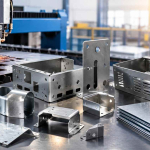

A batch of fabricated metal brackets arrives at your assembly unit. Everything looks fine until the mounting holes refuse to align. Production stops. The supplier blames the drawing, and your procurement team is left dealing with the delay.
That's what poor quality control in Sheet Metal Fabrication can cost a business.
For OEMs and industrial buyers, quality is not simply about appearance. Material grades, dimensional tolerances, weld strength, surface finishing and inspection records all matter. Reliable manufacturers must control these details before components leave the factory.
The Details That Decide Whether a Part Fits
Sheet Metal Fabrication involves cutting, bending, punching, welding and assembling metal sheets into functional industrial components.
Material Grades, Thickness and Tolerances
Common materials include stainless steel, mild steel, aluminium and galvanised steel. Applications range from electrical enclosures and automotive brackets to machinery panels and structural supports.
Here's what buyers frequently miss: specifying stainless steel without mentioning the grade can lead to expensive misunderstandings.
SS304 and SS316 are not interchangeable in every operating environment.
Dimensional accuracy matters just as much. ISO 9013:2017 provides classifications and quality tolerances for thermal cutting processes, including laser and plasma cutting. However, the applicable tolerance must still be agreed upon for each drawing.
Welding, Finishing and Inspection Requirements
Weld quality should be evaluated against the component's actual service requirements. ISO 3834-2:2021 defines quality requirements for fusion welding of metallic materials.
Powder coating thickness, surface preparation, burr removal and corrosion resistance should also be specified before production begins.
A visually acceptable component can still fail during assembly.
Five Quality Checks Every Procurement Manager Should Demand
Choosing between Sheet Metal Fabrication Parts Manufacturers requires more than comparing quotations.
- Material traceability: Ask for grade identification and material test certificates where required. Bad answer: "We purchase good-quality steel from the market."
- Dimensional inspection: Request measurement reports against critical drawing dimensions. Bad answer: "Our machines are accurate, so checking every detail isn't necessary."
- Welding control: Check the applicable welding procedure, operator qualifications and inspection requirements. Bad answer: "Our welders have years of experience."
- Surface finishing: Specify coating type, thickness and acceptance criteria. Bad answer: "We will apply our standard finish."
- Documented quality systems: Review applicable certifications, inspection records and corrective-action procedures. Bad answer: "Our certificate is being renewed; we'll send it later."
A supplier who cannot explain how rejected components are handled is a procurement risk, regardless of price.
How Proper Quality Standards Protect Your Profit Margins
Consistent quality delivers measurable operational advantages.
- Fewer rejected parts: Dimensional inspection catches mistakes before complete batches are dispatched.
- Lower assembly costs: Correct hole positions and bending angles reduce fitting and rework.
- Reduced material disputes: Traceability helps establish whether the specified grade was supplied.
- Better durability: Proper welding and surface treatment reduce premature component failures.
- Predictable production: Approved samples and repeatable processes reduce variation between batches.
- Lower replacement costs: Documented inspection records help resolve defects without prolonged disagreements.
And yet, some buyers still award contracts based entirely on the lowest per-piece rate.
That's a poor purchasing decision when rejected material, sorting labour and production downtime can exceed the original saving.
Sheet Metal Fabrication Parts Availability Across India
India has established industrial manufacturing clusters around Gurugram, Noida, Faridabad, Pune, Chennai and other major production centres.
Buyers searching for Sheet Metal Fabrication Parts Suppliers in India should examine manufacturing location, transport arrangements and inspection capability together.
Integrated Solutions lists its manufacturing location in the Gurugram area, with fabrication services promoted for Noida and other industrial markets.
Location affects more than freight charges.
For example, a procurement team in Delhi-NCR may find it easier to coordinate prototype reviews and corrective actions with a nearby manufacturing facility. For distant buyers, however, packaging standards and dispatch planning become equally important.
Sheet Metal Fabrication Parts Exporters face additional requirements, including destination-specific documentation, packaging and buyer inspection conditions.
About Integrated Solutions: From Drawings to Fabricated Assemblies
At Integrated Solutions, we have been working in engineering and manufacturing since 2004.
We support industrial buyers with design assistance, tooling, sheet metal cutting, CNC punching, bending, welding, finishing and assembly.
Our fabrication work includes stainless steel components, industrial panels, custom parts and OEM assemblies.
We understand that a finished part is not necessarily an acceptable part. A bracket can pass a visual inspection and still cause problems when its mounting holes are checked against the mating assembly.
That's why we place importance on drawing requirements, dimensional accuracy and inspection during manufacturing.
We also support custom manufacturing requirements based on customer drawings and application needs.
At Integrated Solutions, we invite procurement teams, OEM buyers and industrial businesses to share their fabrication requirements.
For an accurate quotation, we request:
- 2D drawings or 3D CAD files
- Material grade and sheet thickness
- Required quantity and delivery location
- Dimensional tolerances and finishing specifications
- Inspection, testing and documentation requirements
We confirm project-specific MOQ, quotation response time and production lead time after reviewing your technical requirements.
Conclusion
Reliable Sheet Metal Fabrication depends on controlled materials, accurate dimensions, dependable welding and documented inspection. The lowest quotation rarely tells the complete story of manufacturing cost. Buyers who define acceptance standards before placing orders are better positioned to prevent disputes and production losses. As industrial requirements become more demanding, traceable quality will increasingly influence supplier selection.
Frequently Asked Questions
1. Which quality standards matter most in Sheet Metal Fabrication?
ISO 9001 addresses quality management systems, while ISO 9013 covers thermal-cut quality classifications and ISO 3834 addresses welding quality requirements. Not every standard applies to every component. The drawing, manufacturing process and customer contract determine what is required.
2. How should buyers evaluate Sheet Metal Fabrication Parts Manufacturers?
Start with material traceability, inspection capability, manufacturing equipment and previous work involving similar components. Ask for actual inspection records rather than relying only on marketing claims.
3. Which materials are commonly used for Sheet Metal Fabrication Parts?
Mild steel, stainless steel, aluminium and galvanised steel are common choices. Selection depends on strength, corrosion exposure, weight and cost. Material substitution should never happen without buyer approval.
4. What should buyers check before selecting Sheet Metal Fabrication Parts Exporters?
Check export documentation capability, packaging, traceability and destination-specific requirements. Export experience alone does not prove that every component meets an overseas customer's technical standards.
5. Can Sheet Metal Fabrication Services handle custom OEM designs?
Yes. Custom work can include laser cutting, CNC bending, welding and assembly. Complex designs may require prototype approval or tooling changes before repeat production.
6. How can Sheet Metal Fabrication Parts Suppliers in India maintain consistency?
By following approved drawings, controlling material batches, checking critical dimensions and recording nonconformities. For critical components, buyers should agree on inspection frequency and acceptance criteria before manufacturing starts.
7. Does a higher price guarantee better fabrication quality?
No. A higher quotation is not proof of quality. Compare material specifications, process controls, inspection requirements and rejection terms before deciding whether the price is justified.