


A bronze bush arrives at the machine shop. The dimensions match the drawing, but the material grade doesn't. Machining begins, the tool behaves differently than expected, and production stops while the buyer asks for another test report. That's the cost of purchasing Bronze Products without checking the material specifications first.
Industrial buyers need more than a competitive quotation. They need consistent alloy composition, accurate dimensions, traceable inspection results and predictable delivery. Choosing reliable Bronze Products Manufacturers means examining these details before issuing a purchase order, not after discovering a problem on the production floor.
Bronze Products Specifications: Grades, Forms and Testing Requirements
Bronze is a family of copper-based alloys, not one material with fixed properties. Different compositions offer different combinations of strength, corrosion resistance, wear performance and machinability.
Common Bronze Products Used in Industrial Manufacturing
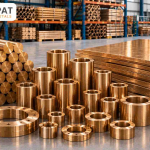
- Bronze Rods and Bars: Used for machining shafts, bushes, bearings and engineering components.
- Bronze Bushes: Suitable for sliding and rotating assemblies where the selected alloy can handle the operating load.
- Bronze Plates and Sheets: Used for fabrication, wear components and industrial assemblies.
- Bronze Ingots: Supplied as casting material for foundries and component manufacturers.
- Custom Bronze Components: Manufactured according to approved drawings, material grades and dimensional requirements.
These product categories are included in Ganga R Ispat Metals' published range.
The Alloy Composition Detail Buyers Often Miss
Consider C93200 bearing bronze. The Copper Development Association specifies a tin range of 6.3–7.5%, lead content of 6–8% and copper content of 81–85%. Those are defined material characteristics, not optional descriptions.
A quotation stating only "bronze material" is inadequate for a critical application.
Buyers should specify the required alloy, manufacturing form, diameter or thickness, dimensional tolerance and applicable test requirements. A grade suitable for a lubricated bearing may be unsuitable for another component exposed to different loads or chemicals. Selecting the correct material takes more work than comparing catalogue prices.
Four Criteria for Evaluating Bronze Products Manufacturers
A supplier assessment should cover these five points before commercial negotiations begin.
- Dimensional Accuracy: Confirm tolerances, measuring methods and inspection records. Bad answer: "Our sizes are usually accurate."
- Manufacturing Capability: Ask whether the required shape is cast, extruded, drawn or machined. Bad answer: "We can manufacture everything," without discussing the process.
- Quality Documentation: Establish whether material certificates and batch identification are available. Bad answer: "We'll arrange certificates after dispatch."
- Delivery and Replacement Terms: Confirm lead time, packing requirements and rejection procedures. Bad answer: "Defective pieces will be handled case by case."
Nobody benefits from discovering unclear replacement terms after a rejected shipment. Buyers should settle acceptance criteria and responsibilities in writing before dispatch.
How Quality Bronze Products Protect Industrial Purchasing Budgets
The advantages of selecting the correct material go beyond mechanical performance.
- Reduced Component Wear: Suitable bearing bronze can limit premature wear under the specified load and lubrication conditions.
- Lower Machining Rejection: Accurate stock dimensions reduce avoidable machining errors and excess material removal.
- Better Corrosion Performance: Correctly selected bronze alloys can reduce corrosion-related replacement in demanding environments.
- Predictable Maintenance: Consistent material properties support more reliable maintenance planning.
- Reduced Procurement Disputes: Agreed inspection records make material acceptance easier to establish.
- Improved Inventory Control: Repeatable specifications make reorder planning more dependable.
One rejected production batch can erase the saving achieved through a lower purchase price.
That's why procurement teams should compare the total usable material cost, including inspection, machining losses, freight and possible replacement, rather than judging suppliers on their initial quotation alone.
Bronze Products Availability Across India's Industrial Markets
Industrial demand comes from machining, automotive, marine engineering, pump manufacturing and heavy equipment production.
Buyers searching for Suppliers in India should examine dispatch arrangements alongside product availability. For example, a buyer in Pune may require regular production stock, while a maintenance contractor in Delhi NCR may need a smaller quantity on a tighter schedule.
Reliable Bronze Products Distributors should distinguish ready stock from material requiring fresh production. These are different commitments.
For buyers evaluating bronze products for sale, freight costs, material weight, protective packing and delivery location also affect the final landed price. Ganga R Ispat Metals publishes bronze product offerings and regional supply pages for Indian markets, but individual stock and dispatch schedules should be confirmed before ordering.
About Ganga R Ispat Metals: Manufacturing and Material Control
At Ganga R Ispat Metals, we work with industrial buyers requiring bronze, brass and other copper-alloy materials for engineering applications.
Our published manufacturing processes include casting, extrusion, cold drawing and finishing. We also describe chemical, mechanical and dimensional testing as part of our quality-control activities.
We understand that a buyer specifying a finished-machining diameter needs to consider the starting stock dimension as well. Choosing material without allowing for machining stock can create problems before production even begins.
We encourage customers to share their application and technical requirements instead of selecting products based only on price.
Send us your required bronze grade, product form, dimensions, tolerances, order quantity, delivery location and any applicable drawings or test requirements.
We invite enquiries for both standard and custom requirements. Our website states an enquiry response time of within 48 hours. Minimum order quantity (MOQ) depends on the selected product and manufacturing requirements, so please confirm the applicable MOQ with our sales team.
Conclusion
Buying Bronze Products requires attention to alloy composition, machining requirements and supplier accountability. Material certificates and written acceptance conditions help reduce purchasing uncertainty. The most useful supplier relationship is one that supports repeatable specifications and dependable communication. Establish those expectations now, before the next production order creates an avoidable problem.
Frequently Asked Questions
1. What should buyers check before ordering Bronze Products?
Check the alloy grade, size, tolerance, application, required certificates and delivery terms. Don't approve a purchase using only a product photograph or general description.
2. How do Bronze Products Manufacturers verify material quality?
Ask for chemical composition reports, dimensional inspection records and relevant mechanical testing. Not every product requires identical testing, so agree on the acceptance standard before ordering.
3. What is the difference between Bronze Products Manufacturers and distributors?
Manufacturers produce or process materials, while Bronze Products Distributors generally source and supply products. Some businesses perform both functions. Confirm who is responsible for manufacturing and inspection.
4. Can Bronze Products Suppliers in India handle custom specifications?
Many can quote custom grades and dimensions. However, tooling, production method and quantity may affect feasibility and lead time.
5. Where can industrial buyers find bronze products for sale?
Start with established industrial metal suppliers and review their product catalogues. Request technical documentation and a formal quotation before confirming payment.
6. Do Bronze Products Distributors provide material certificates?
Some provide manufacturer-issued certificates or batch documentation. Availability varies, so request the exact documents needed before placing an order.
7. What minimum order quantity applies to Bronze Products?
MOQ depends on the alloy, dimensions, product form and whether the material is available from stock. Obtain written confirmation from the supplier rather than assuming one MOQ applies across all products.