

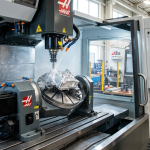




Modern CNC machining requires accuracy, repeatability, and efficient production. When a component needs machining on multiple sides or at several angles, repeatedly removing and repositioning it can increase setup time and introduce alignment errors. A CNC rotary table helps solve this problem by rotating a workpiece to programmed positions or moving it continuously during machining.
For manufacturers working with milling, drilling, indexing, and complex component production, a rotary table can improve flexibility and reduce unnecessary manual operations. Selecting the correct machining accessories and cutting tools is equally important for achieving consistent results.
Whether you need reliable industrial tooling, want to buy carbide inserts dubai, or are comparing cnc cutting tools price uae, understanding how a CNC rotary table works can help you make better equipment and tooling decisions. Khokhawala Trading LLC supports industrial machining requirements with a focus on practical tooling needs.
Table of Contents
-
What Is a CNC Rotary Table?
-
How Does a CNC Rotary Table Work?
-
Main Types of CNC Rotary Tables
-
Which Machining Applications Need a CNC Rotary Table?
-
Benefits of Using a CNC Rotary Table
-
How to Choose the Right CNC Rotary Table
-
Common Mistakes to Avoid
-
Frequently Asked Questions
-
Conclusion and Call to Action
1. What Is a CNC Rotary Table?
A CNC rotary table is a precision workholding and positioning device that rotates a workpiece around a controlled axis. It is typically installed on a CNC milling machine or machining center and controlled through a compatible CNC system.
Depending on the design, the table can rotate the workpiece to specific angles or move continuously while the cutting tool removes material.
Adding a suitable rotary axis can expand a machine's capabilities beyond conventional three-axis machining. A single rotary axis is commonly called a fourth axis, while certain configurations with two rotary axes support five-axis machining.
Key Components of a CNC Rotary Table
A typical CNC rotary table includes:
-
Rotary platform: The surface where the workpiece or fixture is mounted.
-
Drive mechanism: Provides controlled rotational movement.
-
Servo motor: Controls the position and movement of the rotary axis.
-
Clamping system: Secures the workpiece and, where applicable, locks the table during cutting.
-
CNC control interface: Coordinates rotary movement with the machine's other axes.
The exact components and capabilities depend on the rotary table model and its intended application.
2. How Does a CNC Rotary Table Work?
A CNC rotary table operates through programmed rotational movement. The operator secures the workpiece, establishes the correct reference position, and programs the required machining sequence.
For example, imagine a metal component that requires four holes spaced equally around its circumference. Instead of manually repositioning the component after each hole, the rotary table can rotate it to the required angular positions.
The basic process is:
-
Mount and secure the workpiece.
-
Set the workpiece reference and machining coordinates.
-
Program the required rotary positions or movement.
-
Perform the machining operation at each position.
-
Inspect the finished component for dimensional accuracy.
Some operations use indexing, where the table rotates to a programmed position and remains stationary during cutting. Other applications require continuous rotary movement coordinated with the machine's linear axes.
The appropriate method depends on the part geometry, cutting forces, accuracy requirements, and CNC configuration.
3. Main Types of CNC Rotary Tables
Understanding the main rotary table configurations helps manufacturers select equipment suited to their machining requirements.
A. Single-Axis CNC Rotary Table
A single-axis rotary table rotates the workpiece around one axis. It is commonly used for circumferential drilling, angular positioning, and machining multiple sides of a component.
It is suitable when the workpiece can be accessed by rotating it around a single direction.
B. Fourth-Axis Rotary Table
A fourth-axis rotary table adds controlled rotational movement to a conventional three-axis CNC machine. It can support indexed machining and, when designed for it, continuous rotary-axis cutting.
Typical applications include machining cylindrical components, cutting grooves, producing bolt-hole patterns, and milling features around a workpiece.
C. Two-Axis or Fifth-Axis Rotary System
A two-axis rotary system provides additional rotational freedom, often through a combination of rotation and tilt. Depending on the machine configuration, it can support 3+2 machining or simultaneous five-axis operations.
These systems are useful when a component has multiple inclined surfaces, angled features, or complex contours that are difficult to access using a single rotary axis.
4. Which Machining Applications Need a CNC Rotary Table?
A CNC rotary table is particularly valuable when the workpiece requires precise angular positioning, machining on several sides, or coordinated rotary movement.
A. Multi-Sided Milling
Components with features on several faces may require repeated repositioning on a conventional CNC machine.
A rotary table can rotate the workpiece to expose different surfaces while helping preserve the relationship between programmed features. This is useful for brackets, housings, mechanical components, and precision metal parts.
B. Drilling Equally Spaced Holes
Rotary tables are frequently used to machine holes arranged in circular patterns.
Examples include:
-
Flanges with bolt-hole circles
-
Circular mounting plates
-
Mechanical housings
-
Rotating equipment components
-
Precision fixtures
Programmed indexing helps maintain consistent angular spacing between holes.
C. Gear and Spline Machining
Certain gear-cutting and spline-machining operations require accurate angular movement between cutting passes. A compatible rotary table can position the workpiece precisely for successive operations.
The required configuration depends on the gear geometry, cutting method, machine capability, and tooling.
D. Cylindrical Components and Shafts
Shafts, rollers, and cylindrical parts may require grooves, flats, slots, or holes at specific angular positions.
A rotary table makes it possible to rotate these components accurately without relying entirely on manual repositioning. Suitable workholding and support are essential, particularly for long or heavy parts.
E. Curved and Helical Features
Some components require curved profiles, spiral grooves, or helical features. When the rotary axis is capable of coordinated continuous motion, it can work with the machine's linear axes to produce these shapes.
Not every rotary table supports this type of cutting. The drive system, control compatibility, backlash, and rigidity must meet the application's requirements.
F. Automotive and General Engineering
Automotive and general engineering manufacturers often produce parts that require several holes, faces, and angled features. A rotary table can reduce repeated setup operations and support consistent production across batches.
G. Aerospace and Precision Components
Certain aerospace and precision-engineering parts have complex geometries and strict dimensional requirements. Multi-axis machining can improve tool access and reduce the need for multiple setups.
The rotary system must be selected according to the workpiece dimensions, required tolerances, machine capabilities, and approved manufacturing process.
5. Benefits of Using a CNC Rotary Table
Improved Positioning Accuracy
Programmable rotary movement helps position workpieces consistently. Reducing repeated manual setup can also help minimize alignment errors between machining operations.
Actual accuracy depends on the rotary table, machine condition, workholding, calibration, and machining process.
Reduced Setup Time
When several machining operations can be completed in one setup, operators spend less time removing, repositioning, and aligning components.
This can be especially beneficial in batch production.
Greater Machining Flexibility
A rotary table expands the range of features that a CNC machine can produce. It may allow manufacturers to machine additional faces, angular holes, and rotary profiles without investing in an entirely new machining center.
Better Production Consistency
Programmed positioning makes repeated machining sequences easier to standardize. When combined with suitable cutting tools and correct machining parameters, this can support consistent component quality.
Potential Cost Savings
Reducing setup time, manual handling, and alignment corrections may lower production costs. However, the overall benefit depends on production volume, tooling expenses, programming requirements, and the cost of integrating the rotary table.
6. How to Choose the Right CNC Rotary Table
Choosing a rotary table involves more than comparing its diameter or maximum rotation speed.
1. Identify the Machining Operation
Determine whether you need fixed-angle indexing, continuous rotation, multi-sided milling, or simultaneous multi-axis machining.
The required motion determines which configuration is appropriate.
2. Check Workpiece Size and Weight
Confirm that the rotary table can safely accommodate the workpiece, chuck, fixture, and any additional support equipment.
Consider the workpiece's center of gravity and rotational inertia, not just its total weight.
3. Evaluate Accuracy and Repeatability
Review the positioning accuracy and repeatability required for the finished component. Tight tolerances may require a higher-precision rotary system and careful calibration.
4. Confirm Machine Compatibility
Check the CNC controller, servo and drive compatibility, available machine travel, mounting arrangement, and work envelope.
The rotary table must integrate correctly with the existing machining center.
5. Consider Cutting Tools and Machining Conditions
Rotary table performance is only one part of the machining process. Tool geometry, cutting speed, feed rate, toolholder rigidity, and workpiece material also influence the final result.
Selecting the correct cutting tools can help improve surface finish, tool life, and machining efficiency.
If your operation requires carbide inserts, consider the workpiece material, insert grade, cutting conditions, and intended application when you buy carbide inserts dubai. When comparing cnc cutting tools price uae, evaluate tool performance, suitability, and expected service life alongside the purchase price.
6. Review Your Production Requirements
Consider the number of components produced, expected cycle time, changeover frequency, and future machining needs.
A simple indexing table may be sufficient for repetitive angular operations, while more complex components may justify a two-axis rotary configuration.
7. Common Mistakes to Avoid
Manufacturers can avoid unnecessary costs and machining problems by checking the following points before selecting or installing a rotary table.
-
Choosing by size alone: Table diameter does not confirm that the system can handle the required load or cutting forces.
-
Ignoring CNC compatibility: An unsuitable controller or servo configuration can complicate integration.
-
Overlooking workholding: Incorrect clamping can allow workpiece movement and reduce machining accuracy.
-
Using the wrong machining mode: Indexing and continuous rotary cutting have different performance requirements.
-
Neglecting calibration: Poor alignment or incorrect rotary-axis calibration can affect feature positions.
-
Ignoring cutting tool selection: An appropriate rotary setup cannot compensate for unsuitable inserts, incorrect cutting parameters, or worn tools.
-
Overlooking machine clearance: The rotating workpiece and fixture must remain clear of the spindle, tools, enclosure, and other machine components.
A careful review of the workpiece drawing, machine specifications, and intended machining sequence helps prevent these issues.
8. Frequently Asked Questions
Q1. What is the main purpose of a CNC rotary table?
Its main purpose is to rotate and position a workpiece accurately during machining. This enables operations such as multi-sided milling, angular drilling, circular hole patterns, and selected rotary contouring applications.
Q2. Does every CNC machine need a rotary table?
No. A rotary table is most useful when parts require angular positioning, multiple machining faces, or rotary-axis movement. Many components can be produced efficiently on a standard three-axis machine.
Q3. What is the difference between a fourth-axis and a fifth-axis rotary system?
A fourth-axis setup typically adds one rotary axis to a three-axis machine. A fifth-axis configuration usually introduces a second rotary axis, often allowing the workpiece to tilt as well as rotate. Exact machine arrangements vary.
Q4. Can a CNC rotary table reduce machining time?
Yes, it can reduce setup and repositioning time when several operations can be completed in one setup. The actual time savings depend on part geometry, programming, production volume, and machine capability.
Q5. Which industries use CNC rotary tables?
They are used in general engineering, automotive manufacturing, aerospace, mold making, machinery production, and other industries that require accurate rotary positioning or multi-sided machining.
Q6. How do I select the right cutting tools for rotary-table machining?
Consider the workpiece material, operation type, cutting parameters, toolholder arrangement, and required surface finish. Carbide inserts and other suitable CNC cutting tools should be selected according to the specific application rather than price alone.
Q7. What should I check before purchasing a CNC rotary table?
Check the required rotary motion, load capacity, table dimensions, positioning accuracy, workholding, machine clearance, controller compatibility, and production requirements. Confirm these details with the machine or equipment supplier before purchasing.
9. Conclusion: Choose the Right Rotary Table for Efficient Machining
A CNC rotary table can expand machining capabilities by enabling accurate angular positioning, multi-sided milling, circular drilling, and selected complex rotary operations. The right configuration can reduce repeated setups, improve production consistency, and help manufacturers use their CNC equipment more effectively.
Before investing in a rotary table, assess your workpiece geometry, required accuracy, machine compatibility, workholding arrangement, and production goals. Pairing the right equipment with suitable cutting tools is equally important for reliable results.
Looking for industrial tooling support? Khokhawala Trading LLC can help you explore your industrial cutting-tool requirements. Whether you want to buy carbide inserts dubai or compare cnc cutting tools price uae, focus on selecting products that suit your machining application, material, and production needs.
Contact Khokhawala Trading LLC to discuss your industrial tooling requirements and identify suitable options for your machining operations.