

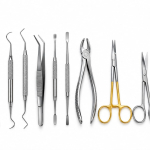

The purchase order says "general dental kit, 50 sets." Nobody has listed the procedures those sets must support. That's how a clinic ends up with five elevators and no curettes.
Procedure decides the kit, not the other way round.
Wholesalers and procurement managers who treat dental equipments as one category repeat this mistake every quarter. The cost arrives later, as idle stock and urgent reorders. Here's a procedure-by-procedure view of what each chair needs. It also shows how to test a supplier against that list.
Six Procedures, Six Trays of Dental Instruments
Hand-held Dental instruments do most of the work below, so this map leaves chairs and compressors for a separate purchase.
- Examination: mouth mirror, explorer and cotton pliers. Check handle balance and mirror fit.
- Scaling: scalers, curettes and periodontal probes. Check tip sharpness and probe markings.
- Extraction: forceps and elevators. Check beak fit and joint play.
- Restorative: excavators, pluggers and spatulas. Check tip shape and finish.
- Endodontic: explorers, pluggers and spreaders. Check tip taper and straightness.
- Orthodontic: pliers, cutters and ligature tools. Check jaw alignment and cutting edge.
Two Elevators, One Code, Different Tips
Two elevators can share a catalogue code and still differ in tip curve and width. Which means every reorder must reproduce the same pattern, and you should check the pattern itself, not only the code.
The Autoclave Is the Real Inspector
Busy surgical and scaling sets return to the autoclave often. A common steam cycle runs at 134°C, and hardness decides how long an edge survives that repetition. That's why makers heat-treat AISI 420, a martensitic stainless steel with 12–14% chromium. Holding that balance lot after lot is harder than any catalogue suggests.
Questions That Make a Supplier Show Its Work
When you compare dental instruments manufacturers, put each check below to them in writing.
- Procedure matching: a good supplier proposes sets from your procedure list. A weak one sends one "universal" catalogue.
- Steel proof: a good supplier names the grade and shares the mill certificate. A weak one says "surgical steel."
- Pattern repeatability: a good supplier reproduces the same pattern on reorder. A weak one promises "something similar."
- Defect terms: a good supplier offers a written policy with a claim deadline. A weak one says "case by case."
- Certification: a good supplier shows an ISO 13485:2016 number and expiry date. A weak one shows a certificate with no number.
"Case by case" has no terms, so you lose that argument once the goods land. Buyers who accept one universal catalogue pay for it in returns and idle stock.
Where Procedure Lists Pay You Back
- Less dead stock: you carry the sets clinics use and skip lines that sit.
- Fewer returns: matched patterns cut wrong-fit complaints.
- Faster reorders: a standard set list shortens every repeat order.
- Cleaner paperwork: instruments belong under HS heading 9018, and consistent set lists make customs documents easier to match.
- Clearer branding: brand owners can label sets by procedure.
Forges Next Door, Delhi 360 km Down the Road
Surgifact sits in Jalandhar, Punjab, at 1382/1046, Raja Garden, Basti Danishmandan, near Vishal Tools (PIN 144002). Local forging, heat-treatment and polishing shops cluster here because the area built its trade on surgical and hand tools. A set change, such as a different tip width, therefore reaches the right workshop fast. From here, Delhi's air cargo terminals lie roughly 360 km by road.
Mapping dental instruments manufacturers in India, dental instruments suppliers in India or dental instruments exporters in India? Ask how fast each revises a pattern.
Fifty-Nine Years of Reorders, One Habit
We're an ISO-certified manufacturer, and we've made dental instruments since 1967. Fifty-nine years of reorders taught us that clinics rarely ask for "a kit." They ask for the extraction set that fits their hand. So every enquiry starts with the procedure.
Your Procedure List Is the Only Brief We Need
Tell us which procedures your clinics run most. Add any pattern or code numbers, how many sets you need, and where they ship. We'll reply with the items we can supply together and a quote for each.
Write the List Before You Write the Order
Procedure lists beat catalogues. Choose Dental instruments manufacturers who build sets around your cases, and your reorders get simpler. Next quarter's orders will reward whoever writes the list first.
Straight Answers Before Your First Order
What is the minimum set of dental instruments for a new clinic?
Start with examination, scaling and extraction sets, since those procedures run daily. Add restorative and endodontic sets once you know the clinic's case mix, which varies.
Can dental instruments suppliers in India build sets by procedure?
Send your procedure list. We'll mark the items we can supply as one set.
What does a buyer send dental instruments exporters in India?
As dental instruments exporters, we need an item list with pattern numbers, quantities and the destination. Import and device rules at your end stay your responsibility.
Is one supplier enough for chairs and hand instruments?
Not from us. We make hand instruments only. For dental equipments such as chairs and compressors, you need a supplier certified for powered devices.
What should I do with a sample set on day one?
Open and close every joint, compare tip shapes against your reference pattern, then run the set through one sterilisation cycle. A sample reflects a single lot, so spot-check your first bulk delivery.
Which papers should arrive with the first shipment?
Ask for the quality certificate with its number, the steel grade for your lot and the packing list. If a supplier hesitates over any of them, you have your answer.