

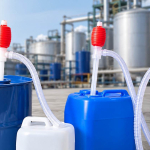

A pump that works perfectly with water may fail within weeks when exposed to an industrial solvent. That's an expensive mistake, especially when a factory has already purchased dozens of units. Choosing the right Siphon Pump involves more than comparing prices or selecting a familiar brand. Material compatibility, liquid viscosity, transfer capacity, and operating conditions all affect performance. Ignore any one of them, and a seemingly inexpensive purchase can become a maintenance problem.
Siphon Pump Specifications That Matter Before Buying
Industrial siphon pump transfer liquids between containers, drums, barrels, and storage tanks. Many manual models use a priming mechanism to initiate flow, followed by gravity-driven transfer where the receiving outlet is positioned below the source liquid level.
Unlike motor-driven pumps, conventional siphon systems do not require electricity to maintain flow once properly primed. However, their performance depends on the liquid properties, tubing arrangement, and available elevation difference.
Material Compatibility Comes Before Pump Capacity
Polypropylene, PVC, and rubber tubing are among the materials used in industrial siphon pump assemblies. Giza Pumps identifies these materials in its product information, but compatibility must still be checked against the exact liquid being transferred.
A pump suitable for lubricating oil isn't automatically suitable for concentrated chemicals. Temperature and exposure duration also matter. And yet, buyers regularly ask about price before sharing the chemical name.
Flow Rate, Tube Diameter, and Priming
A siphon pump's transfer rate depends partly on the internal tube diameter, liquid viscosity, tubing length, and elevation difference.
Here's the detail that often gets missed: the receiving outlet must be positioned appropriately below the source liquid level for gravity-driven siphoning to continue. A pump that primes successfully may still stop transferring if the installation does not provide sufficient hydraulic head.
Air leaks, restrictive bends, and incorrect priming can create further problems. Research on siphon fluid mechanics confirms that elevation differences and flow resistance directly influence performance.
Choosing Between Drum and Heavy Barrel Models
Giza Pumps lists two siphon-related product categories: Siphon Drum Pump and Siphon Heavy Barrel Pump. The appropriate choice depends on container dimensions, fluid characteristics, and operating requirements.
Before ordering, check the suction tube length, hose arrangement, connection dimensions, and whether replacement components are available.
Five Supplier Checks That Protect Your Purchase
Buying from Siphon Pump Manufacturers should involve a technical discussion, not just a catalogue comparison.
- Chemical compatibility: Ask for material specifications and confirmation for your liquid. A bad answer is, "It works with every chemical." No single material is compatible with every industrial fluid.
- Flow performance: Request transfer capacity under relevant operating conditions. A bad answer is, "Our pump transfers liquid very fast," without any measurable information.
- Construction and leakage control: Check seals, connections, tube quality, and assembly consistency. A supplier who dismisses leakage concerns without explaining testing procedures is creating risk for the buyer.
- Bulk order consistency: Confirm whether supplied units will match the approved sample. A bad answer is, "Production quality is usually the same." For procurement teams, usually isn't an acceptance standard.
- Warranty and replacement support: Ask who handles defective units and what documentation is required. A bad answer is, "We will decide after delivery." That leaves the entire dispute unresolved until the buyer has already paid.
Getting these five points documented before purchase makes supplier comparisons more meaningful.
Six Ways the Right Siphon Pump Protects Operating Margins
The benefit of a correctly selected pump isn't simply easier liquid transfer. It is the reduction of avoidable operating expenses.
- Reduced liquid wastage: Suitable tubing and secure connections help limit spills during routine transfers, protecting valuable oils and chemicals.
- Lower electricity dependence: Manual gravity-assisted siphon systems can operate without an electrical supply, reducing the need for powered equipment in suitable applications.
- Less operator downtime: Easy priming and appropriate container fit can reduce time spent repositioning equipment or correcting interrupted flow.
- Better chemical handling: Compatible wetted materials reduce the risk of premature component degradation and contamination.
- Lower replacement expenditure: Matching the equipment to actual operating conditions helps prevent unnecessary purchases caused by early wear.
- More predictable procurement: Consistent specifications and documented acceptance checks reduce disagreement between purchasing teams and suppliers.
None of these benefits compensates for choosing the wrong material.
Siphon Pump Availability and Industrial Supply Across India
For buyers comparing Siphon Pump Suppliers in India, location influences freight planning, replacement availability, and communication during urgent orders. Giza Pumps operates from Shapar, Rajkot, Gujarat, at Sub-Plot 3/1, Plot No. 3, Dholera Main Road, Shapar, Rajkot, Gujarat – 360024. Its website lists industrial siphon pump products for buyers across India.
Rajkot's established engineering and manufacturing ecosystem offers a relevant sourcing location for industrial buyers. Still, location alone doesn't guarantee shorter delivery times.
Siphon Pump Dealers should verify stock before promising dispatch. Similarly, Siphon Pump Wholesalers supplying customers in multiple states need to account for packaging, freight, and replacement logistics. A lower ex-factory quotation can quickly become less attractive when transport charges and delivery uncertainty enter the calculation.
About Giza Pumps: Industrial Liquid Transfer Solutions
At Giza Pumps, we focus on industrial liquid transfer equipment for applications involving drums, barrels, and storage containers. Our published siphon pump range includes both Siphon Drum Pump and Siphon Heavy Barrel Pump options.
We operate from Shapar, Rajkot, Gujarat, where our listed contact point supports product enquiries for industrial customers. We recognise that choosing a siphon pump requires attention to the liquid being transferred, container dimensions, and actual usage conditions.
We encourage buyers to verify application suitability before committing to larger orders, particularly when chemical compatibility or specialised operating conditions are involved.
We invite procurement managers, industrial buyers, dealers, and distributors to contact Giza Pumps with their requirements.
We ask buyers to share the liquid name, approximate viscosity, operating temperature, container size, required quantity, delivery location, and expected transfer capacity. With these details, we can discuss suitable product options and quotation requirements.
We confirm minimum order quantity (MOQ), stock availability, dispatch schedules, and quotation response time directly during the enquiry process rather than promising an unverified fixed turnaround.
Conclusion
Selecting the right Siphon Pump requires careful attention to liquid compatibility, flow conditions, construction quality, and supplier accountability. A low purchase price means little if frequent replacements or leakage increase operating costs. Industrial buyers who establish clear specifications before placing orders will be better positioned to control expenses and improve liquid handling in future operations.
Frequently Asked Questions
1. What should I check before buying an industrial Siphon Pump?
Start with the liquid type, chemical compatibility, viscosity, container depth, and discharge arrangement. Ask for material details and operating limitations. Without these specifications, comparing models based only on price is unreliable.
2. Can a siphon pump transfer industrial chemicals?
Yes, provided the wetted components are compatible with the chemical. Not every pump handles every acid, solvent, or concentrated solution safely. Buyers should confirm the exact chemical concentration and operating temperature before purchase.
3. How should I compare Siphon Pump Manufacturers?
Compare material specifications, product consistency, application support, and replacement policies. Request technical documentation where available. A manufacturer quoting the lowest price isn't necessarily offering the lowest operating cost.
4. Do Siphon Pump Dealers supply replacement parts?
Some dealers may provide hoses, seals, or other components, but availability varies by product and supplier. Confirm replacement-part availability and compatibility before purchasing multiple units.
5. What should bulk buyers ask Siphon Pump Wholesalers?
Ask about MOQ, quantity-based pricing, packaging, shipment schedules, and defective-product handling. For recurring orders, confirm whether subsequent batches will match the approved sample.
6. How can I select reliable Siphon Pump Suppliers in India?
Check the supplier's business address, product specifications, communication quality, and dispatch commitments. For industrial applications, request evidence of material suitability rather than relying entirely on catalogue descriptions.
7. Can an industrial siphon pump operate without electricity?
A manually primed, gravity-driven siphon can transfer suitable liquids without electricity when the necessary elevation difference exists. However, it won't work in every layout. If the receiving container is higher than the source and no separate pumping force is available, a conventional gravity siphon is not the correct solution.