

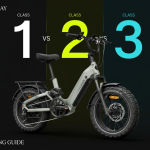




Black Friday 2026 is an excellent opportunity to upgrade your daily commute, explore new trails, or purchase your first electric bike. However, with so many models and discounts available, choosing the right ebike can be confusing, especially when comparing Class 1, Class 2, and Class 3 electric bikes.
Understanding these three classifications is essential because they determine how fast your ebike can travel with motor assistance, whether it has a throttle, and where you can legally ride it.
Before shopping for the best black friday e bike deals, this guide will help you understand the differences between the three ebike classes, compare their advantages, and choose the right electric bike for your riding needs and budget.
What Are the Three Classes of Ebikes?
In the United States, electric bikes are commonly divided into three categories based on their motor assistance and maximum assisted speed.
Class 1 Ebikes: Pedal-Assist Only
Class 1 electric bikes provide motor assistance only when the rider pedals. The motor stops providing assistance once the bike reaches 20 mph.
Key Features:
-
Maximum assisted speed: 20 mph
-
Motor activation: Pedal assistance only
-
Throttle: Not permitted for propulsion
-
Best for: Beginners, recreational cyclists, and casual commuters
-
Typical riding locations: Bike lanes, roads, and many designated bicycle paths
Advantages:
Class 1 ebikes provide a natural cycling experience while reducing the physical effort required to climb hills or travel longer distances.
They are particularly suitable for riders who want exercise without becoming exhausted during their commute.
Disadvantages:
Because Class 1 ebikes require pedaling to activate the motor, they may be less convenient for riders who prefer throttle-powered acceleration.
Class 2 Ebikes: Pedal Assist and Throttle
Class 2 electric bikes offer both pedal assistance and throttle-powered propulsion, with motor assistance limited to 20 mph.
Key Features:
-
Maximum motor-powered speed: 20 mph
-
Motor activation: Pedal assistance or throttle
-
Throttle: Yes
-
Best for: Commuters, recreational riders, and people seeking flexible riding options
-
Typical riding locations: Roads, bike lanes, and many bicycle paths where permitted
Advantages:
The biggest benefit of Class 2 ebikes is flexibility.
Riders can pedal for exercise or use the throttle when starting from a stop, navigating traffic, or taking a break from pedaling.
Class 2 models are especially attractive to beginners and riders who want a convenient transportation alternative.
Disadvantages:
Frequent throttle use can reduce battery range compared with moderate pedal assistance.
Additionally, some trails and recreational paths restrict throttle-equipped electric bikes.
Class 3 Ebikes: Faster Pedal-Assisted Riding
Class 3 electric bikes are designed for riders who want higher assisted speeds, particularly for commuting and longer road journeys.
Key Features:
-
Maximum pedal-assisted speed: 28 mph
-
Motor activation: Primarily pedal assistance
-
Throttle: Rules vary by state
-
Best for: Experienced riders, long-distance commuters, and road cycling
-
Typical riding locations: Public roads and designated bike lanes where permitted
Advantages:
Class 3 ebikes allow riders to cover longer distances more efficiently, making them attractive for daily commuting.
The higher assisted speed can also make them practical alternatives to cars for certain journeys.
Disadvantages:
Higher speeds require greater attention to braking distance, traffic conditions, and rider safety.
Some states impose additional age requirements or restrictions on Class 3 ebikes, particularly on shared-use paths.
Class 1 vs Class 2 vs Class 3 Ebikes: Quick Comparison
|
Feature |
Class 1 |
Class 2 |
Class 3 |
|---|---|---|---|
|
Maximum assisted speed |
20 mph |
20 mph |
28 mph |
|
Pedal assistance |
Yes |
Yes |
Yes |
|
Throttle |
No |
Yes |
Varies by state |
|
Beginner-friendly |
Excellent |
Excellent |
Moderate |
|
Commuting |
Good |
Excellent |
Excellent |
|
Recreational riding |
Excellent |
Excellent |
Good |
|
Bike path access |
Generally broad |
Varies locally |
Often restricted |
|
Battery efficiency |
Generally good |
Depends on throttle use |
Depends on speed |
|
Best for |
Casual cycling |
Versatile riding |
Faster commuting |
Note: Ebike classifications and access rules vary by state and local jurisdiction. Many states also specify a motor power limit of 750 watts or less.
Which Ebike Class Is Best for Black Friday 2026?
The best electric bike class depends on how you plan to use your bike.
Best for Beginners: Class 1 or Class 2
If you are purchasing your first electric bike, Class 1 and Class 2 models are excellent starting points.
Class 1 offers a traditional cycling experience, while Class 2 provides additional convenience through throttle control.
For riders who want flexibility without excessive assisted speed, Class 2 is often the better choice.
Best for Daily Commuting: Class 2 or Class 3
Commuters should consider travel distance, road conditions, and traffic.
Class 2 ebikes are suitable for urban environments where frequent stops make throttle assistance useful.
Class 3 ebikes are attractive for longer commutes because their higher assisted speeds can reduce travel time.
Best for Recreational Riding: Class 1
Class 1 ebikes are often a practical option for recreational cycling because they are accepted on many bicycle paths and shared-use routes.
However, trail access varies, so always check local regulations before riding.
Best for Versatility: Multi-Class Ebikes
Some electric bikes allow riders to select different operating modes to accommodate different riding environments.
These models can be particularly attractive during Black Friday because one bike may serve multiple purposes.
However, switching modes does not automatically make a bike legally compliant with every class. Its equipment, labeling, and configuration must satisfy applicable regulations.
Recommended Black Friday Ebike: Himiway D5 2.0 20"
For shoppers looking for a versatile electric bike that combines comfort, power, and practical everyday features, the Himiway D5 2.0 20" is worth considering.
Unlike basic commuter ebikes, the Himiway D5 2.0 20" combines fat tires, full suspension, and a powerful motor to accommodate different riding conditions.
Key Specifications
|
Specification |
Himiway D5 2.0 20" |
|---|---|
|
Motor |
750W |
|
Maximum torque |
90 Nm |
|
Battery |
48V 15Ah |
|
Maximum advertised range |
Up to 70 miles with pedal assistance |
|
Throttle range |
Up to 40 miles |
|
Payload capacity |
440 lbs |
|
Suspension |
Full suspension |
|
Transmission |
8-speed |
|
Supported riding modes |
Class 1, 2, and 3 configurations |
|
Recommended rider height |
4'11"–6'3" |
Why Consider the Himiway D5 2.0 20"?
1. Flexible Riding Modes
The Himiway D5 2.0 20" supports configurable riding modes, making it appealing to riders who want different levels of assistance for different situations.
Always configure the bike according to local laws and verify its classification before riding.
2. Powerful 750W Motor
Its 750W motor delivers up to 90 Nm of torque, providing useful assistance when climbing hills, accelerating, or carrying additional cargo.
3. Full Suspension for Improved Comfort
The combination of front and rear suspension helps absorb bumps and vibrations when riding on uneven roads, gravel, and recreational paths.
This can be particularly valuable for riders who prioritize comfort during longer journeys.
4. Long-Distance Riding Capability
With an advertised pedal-assist range of up to 70 miles, the D5 2.0 20" can accommodate daily commuting and weekend adventures.
Actual range depends on rider weight, terrain, weather, speed, and assistance level.
5. High Payload Capacity
Its 440-lb maximum payload makes it suitable for a wide range of riders and cargo-carrying needs, provided the total load stays within the manufacturer's limits.
For Black Friday shoppers comparing commuter and recreational electric bikes, the Himiway D5 2.0 20" offers a compelling combination of versatility, comfort, and utility.
How to Find the Best Black Friday E Bike Deals in 2026
Black Friday falls on November 27, 2026, and many electric bike retailers may begin offering promotions before the official shopping weekend.
However, a large discount does not always mean the bike represents good value.
Here are the most important factors to consider.
1. Compare Actual Prices, Not Just Discount Percentages
Some retailers advertise impressive percentage discounts based on higher reference prices.
Instead of focusing exclusively on the advertised savings, compare the final selling price with the bike's recent regular price and similar competing models.
Also check whether shipping, assembly, or accessories add to the total cost.
2. Check Battery Capacity and Range
Battery capacity is one of the most important factors affecting electric bike performance.
It is typically measured in watt-hours (Wh).
The calculation is:
Battery Capacity (Wh) = Voltage (V) × Amp-Hours (Ah)
For example, the Himiway D5 2.0 20" uses a 48V 15Ah battery:
48 × 15 = 720 Wh
A larger battery generally provides more potential riding range, although motor efficiency, speed, terrain, and rider weight also matter.
3. Look for Reliable Braking Systems
Safety should remain a priority regardless of the discount.
Consider electric bikes with:
-
Hydraulic disc brakes
-
Brake cut-off sensors
-
Integrated front and rear lights
-
Reliable tires with appropriate traction
-
Clearly displayed speed and battery information
These features become particularly important when riding heavier electric bikes or traveling at higher speeds.
4. Evaluate Motor Power and Torque
Motor wattage and torque influence how an electric bike performs under load.
For flat urban roads, moderate motor power may be sufficient.
For hills, heavier riders, and cargo transportation, higher torque can be beneficial.
A 750W electric bike with strong torque can provide additional flexibility, although buyers should ensure the motor meets their local legal requirements.
5. Check Battery Safety Certifications
When comparing discounted ebikes, pay attention to recognized electrical safety standards.
Look for applicable certifications such as:
-
UL 2849: Electrical systems for electric bicycles
-
UL 2271: Batteries for light electric vehicles
Verify certification claims rather than assuming that every discounted model has undergone independent testing.
6. Review Warranty and Customer Support
An inexpensive electric bike may become costly if replacement batteries, motors, or controllers are difficult to obtain.
Before buying, review the manufacturer's warranty, return policy, replacement parts availability, and customer support options.
7. Compare Black Friday Bundles
Some of the most valuable promotions include accessories rather than direct price reductions.
Look for offers that may include extra batteries, helmets, locks, racks, or other accessories.
An additional battery can be particularly useful for riders who frequently travel long distances.
Should You Buy a Class 1, Class 2, or Class 3 Ebike on Black Friday?
Here is a simple buying framework.
|
Your Main Priority |
Recommended Class |
|---|---|
|
Beginner-friendly cycling |
Class 1 |
|
Pedaling and throttle flexibility |
Class 2 |
|
Faster daily commuting |
Class 3 |
|
Recreational paths |
Class 1, subject to local rules |
|
Stop-and-go city traffic |
Class 2 |
|
Longer road commutes |
Class 3 |
|
Versatile everyday riding |
Compliant multi-class model |
For many buyers, Class 2 provides an excellent balance between accessibility and convenience.
However, riders who want higher commuting speeds may prefer Class 3, while recreational cyclists may find Class 1 sufficient.
Frequently Asked Questions
Are Class 3 Ebikes Better Than Class 2?
Not necessarily.
Class 3 ebikes offer higher pedal-assisted speeds, but Class 2 models provide throttle convenience.
The better option depends on your commute, riding preferences, and local regulations.
Can a Class 2 Ebike Go Faster Than 20 MPH?
Yes. A Class 2 ebike can exceed 20 mph through pedaling or downhill momentum, but its motor must stop providing propulsion at the class's 20 mph limit.
Are Class 3 Ebikes Legal Everywhere?
No. Class 3 regulations vary by state and locality.
Some jurisdictions impose minimum rider ages, helmet requirements, or restrictions on bicycle paths.
Always verify applicable regulations before purchasing.
Do Class 3 Ebikes Use More Battery?
They can.
Riding at higher speeds generally increases aerodynamic resistance and energy consumption, reducing range.
However, actual battery usage depends on the bike's motor, rider input, terrain, and riding conditions.
Is Black Friday a Good Time to Buy an Ebike?
Black Friday can be an excellent opportunity to purchase an electric bike at a reduced price, particularly when retailers offer genuine discounts or valuable accessory bundles.
However, compare prices in advance to confirm that the promotion provides meaningful savings.
Which Ebike Is Best for Both Commuting and Weekend Adventures?
A versatile fat-tire electric bike with comfortable suspension, sufficient battery capacity, and appropriate riding modes can be a practical option.
The Himiway D5 2.0 20" is one model worth evaluating because it combines a 750W motor, full suspension, and an advertised pedal-assist range of up to 70 miles.